
Energy products are becoming increasingly sophisticated. Tariffs are more customized, pricing logic is more contextual, and customers expect greater transparency. At the same time, utility teams need more control without compromising operational reliability as complexity grows.
Our latest product updates respond directly to these needs. From automated PPA billing and more intuitive Time-of-Use tariff creation to price cap and floor and AI-assisted bill explanations, these improvements make advanced energy products easier to launch, operate, and understand.
Power Purchase Agreements (PPAs) allow commercial and industrial customers to procure renewable energy directly from producers. However, billing these products becomes challenging when multiple production sources, sites, members, and pricing models are involved.
exnaton automates the complete allocation and settlement process, enabling utilities to manage sophisticated PPA products without relying on manual calculations or fragmented workflows.
.png)
With exnaton, utilities can:
This enables utilities to offer structured renewable-energy products to commercial and industrial customers while keeping even complex portfolios scalable and operationally manageable.
Creating Time-of-Use (ToU) tariffs is now more visual, flexible, and intuitive.
Any eligible rate component can be changed from “Always” to “On a Schedule.” Utility teams can then define the days and hours during which it applies, including multiple schedules and time windows.
A live coverage panel visualizes the complete week as the tariff is created. Users can immediately identify which hours are covered, where gaps remain, and where multiple components overlap.
.png)
Key improvements include:
If tariff components overlap, the editor explains that the corresponding charges will be combined. It also permits gaps in the schedule, giving teams the flexibility to create products that deliberately apply only during selected hours.
This makes it possible to implement products such as happy-hour tariffs, different day and night prices, or tariffs that alternate between fixed and index-based pricing throughout the day.
The new editor transforms tariff creation from a primarily technical configuration task into a transparent workflow in which teams can see and validate pricing logic as they build.
The improved Time-of-Use tariff editor is already available in production.
Market-linked tariffs give customers access to changing energy prices but utilities may still want to protect customers and their own margins from extreme market movements.
Index-formula rate tariffs can now include a minimum and maximum price. These limits create a predefined price corridor around an otherwise dynamic pricing model.
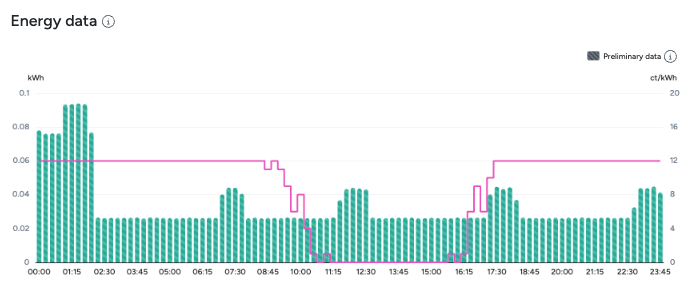
Utilities can use this functionality to offer bounded dynamic tariffs that combine market responsiveness with greater predictability. For example, a tariff can follow an energy-market index while ensuring that the resulting price never drops below an agreed floor or exceeds a defined cap.
The configured limits are also reflected in the customer-facing price chart. Customers can therefore see not only how the tariff follows the market, but also when the price floor or cap takes effect.
By making the underlying pricing logic visible, utilities can explain more sophisticated tariff models clearly and strengthen customer trust.
Electricity bills contain a wealth of information, but their complexity often makes them one of the least transparent – and most support-intensive – customer touchpoints.
Our new Bill Explainer prototype explores how AI can change that.
Users upload an electricity bill as a PDF, and the tool analyzes its contents and explains the individual components in plain language. It can also provide relevant regulatory context and display a personalized product recommendation.
The current prototype:
For utilities, this creates opportunities beyond service automation. A bill explanation can become a starting point for helping customers understand their consumption, discover a more suitable tariff, or adopt smarter energy products.
The Bill Explainer can be white-labeled and embedded into a utility’s website, customer portal, or app. Its regulatory knowledge and recommendation logic can also be adapted to individual markets and product portfolios.
The current version is a customer-ready prototype that we are now presenting to interested utilities and developing further based on their feedback.
The energy transition requires more than new tariff concepts. Utilities also need the operational tools to configure, bill, explain, and scale them reliably.
These latest updates address that complete lifecycle: from managing renewable-energy portfolios and building contextual pricing models to protecting customers from price extremes and communicating complex bills more clearly.
Together, they make advanced energy products more manageable for utility teams, and more transparent for the customers using them.