
Time-of-Use (ToU) tariffs are rapidly becoming a key electricity pricing model as energy systems become more dynamic and decentralized. Instead of paying a flat rate for electricity at all times, consumers are charged different prices depending on when they use electricity during the day. This shift reflects the real cost of generating and supplying electricity and plays a critical role in enabling a more flexible and efficient energy system.
At its core, a Time-of-Use tariff divides the day into several pricing periods. Typically, these include peak, flat (or mid-peak), and off-peak periods. Electricity is most expensive during peak hours, when demand on the grid is highest. Prices are lower during mid-peak periods and cheapest during off-peak hours, when demand drops and electricity is easier and cheaper to supply.
A Time-of-Use tariff is an electricity pricing structure where the cost per kilowatt-hour varies depending on the time of day. Rather than paying a single fixed rate, consumers are incentivized to shift their electricity usage to times when demand is lower.
In most modern ToU structures, the day is divided into three main periods.
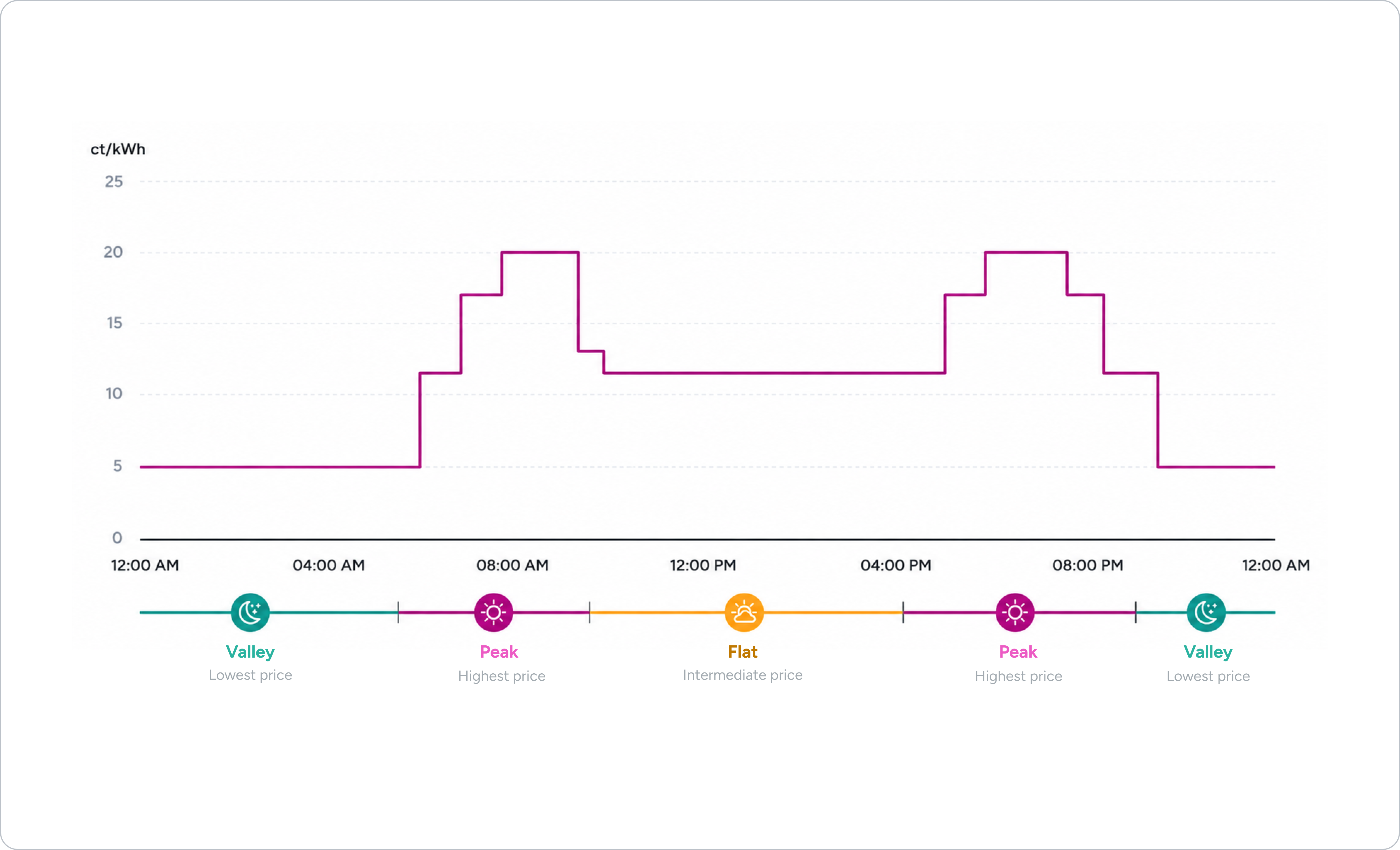
This model encourages consumers to be more conscious of when they use electricity. Running appliances, charging electric vehicles, or operating heating systems during off-peak hours can significantly reduce energy costs.
Time-of-Use tariffs reflect the reality that electricity is not equally expensive to produce at all times. During periods of low demand – such as late at night – electricity is typically generated by lower-cost and inflexible generation sources (e.g. nuclear, run-of-river hydro), making it relatively inexpensive. However, during peak demand periods, utilities often need to activate more expensive generation sources, such as gas-fired power plants, or purchase electricity on short notice from the wholesale market at higher prices.
ToU tariffs align consumer prices with these fluctuating costs. When demand and production costs are high, prices increase. When demand is low, prices decrease. This creates a direct economic signal for consumers to adjust their behavior by shifting consumption to lower-cost periods.
For example, many utilities structure their tariffs so that off-peak hours fall between late evening and early morning – often within a window like 11 p.m. to 6 a.m. In contrast, peak hours typically occur in the late afternoon and evening, when energy demand surges due to residential and commercial activity.
The transition to Time-of-Use tariffs is driven by the increasing complexity of modern energy systems. Electricity demand fluctuates throughout the day, influenced by weather, human behavior, and the growing adoption of electric technologies such as EVs and heat pumps.
Utilities must continuously manage procurement and balancing in response to supply and demand dynamics. During peak periods, this often requires:
Flat-rate pricing masks these cost fluctuations, meaning consumers have little visibility into when electricity is most expensive. ToU tariffs solve this by making price signals transparent and actionable for end consumers.
By encouraging consumers to shift consumption away from peak periods, ToU tariffs help reduce peak load, defer grid investments, improve system efficiency, and lower overall system costs.
Time-of-Use pricing is not limited to the energy component of electricity bills – it is increasingly being applied to grid fees (network charges) as well. This represents a significant evolution in how distribution system operators (DSOs) recover costs and manage grid congestion, particularly as the adoption of controllable devices like heat pumps, EV chargers, and battery storage accelerates.
Germany provides one of the most advanced examples through §14a of the Energy Industry Act (EnWG), which came into full effect in January 2024. The regulation allows DSOs to temporarily reduce the power output of certain controllable devices during periods of peak grid load, in exchange for reduced grid fees. This framework is designed to prevent grid overloads while maintaining device functionality and providing financial incentives for consumer participation.
Starting April 1, 2025, all German distribution network operators became required to offer time-variable grid fees (Module 3) for households with controllable devices, alongside standard tariff options. Under this structure, grid fees fluctuate based on grid utilization: they increase during periods of high demand (e.g., evening hours when households are cooking and using appliances) and decrease during low-demand periods such as late at night.
The regulation offers three modules for consumers:
Time-variable grid fees offer DSOs a powerful tool to manage grid congestion without costly infrastructure upgrades. By creating price signals that encourage consumers to shift flexible loads – such as EV charging or heat pump operation – away from peak periods, grid operators can defer or avoid distribution network expansion. Research shows that dynamically adjusted tariffs aligned with real-time grid conditions are significantly more effective at reducing congestion than static ToU tariffs designed around typical daily load profiles.
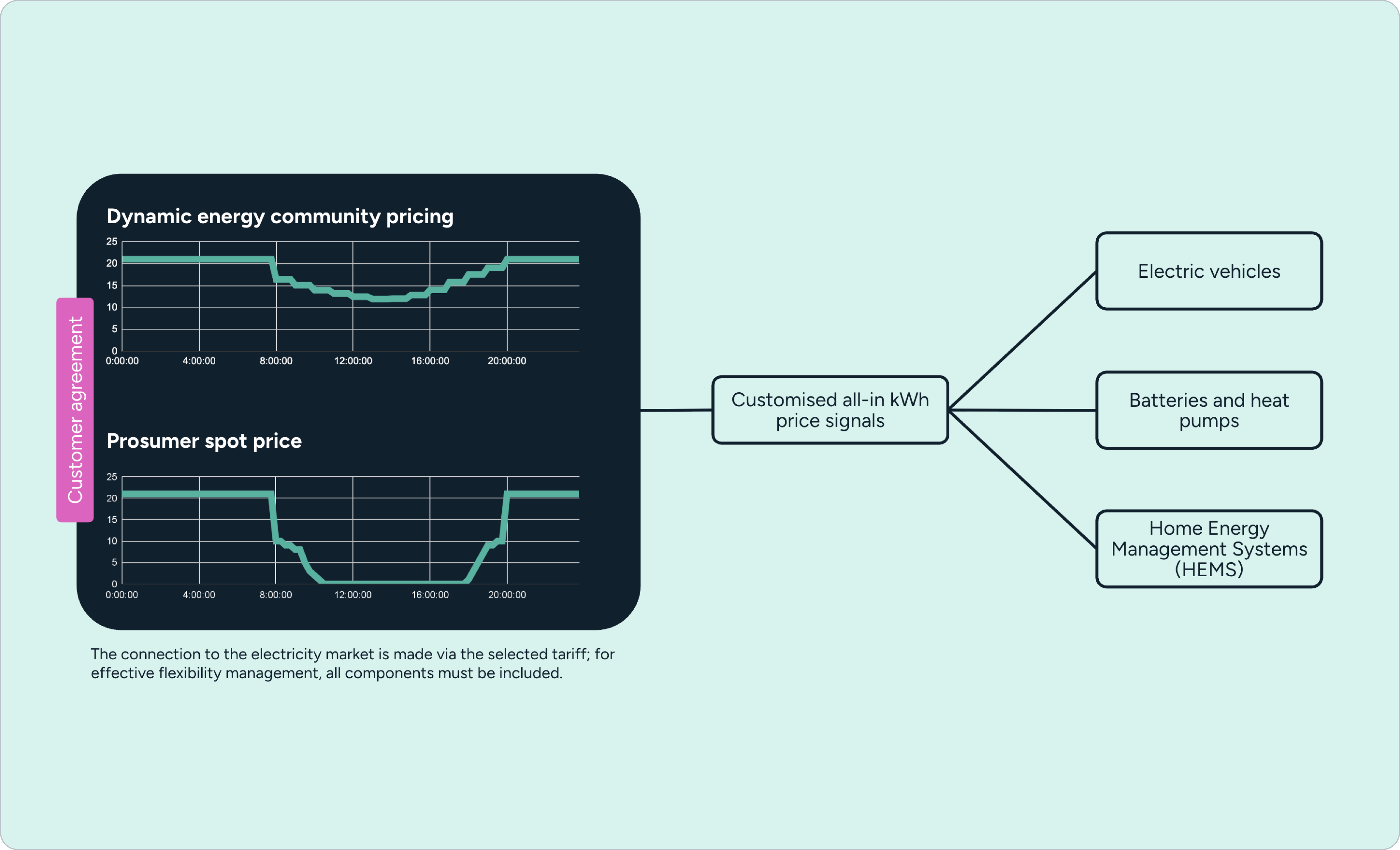
For utilities, this model also supports regulatory compliance and positions them competitively as the energy transition accelerates. Customers benefit from tangible cost reductions (studies indicate average savings of around 40% on grid charges with time-variable tariffs), while DSOs gain operational flexibility and improved grid stability.
The evolution continues with the AGNES regulation (Agile Network Price Structure), expected to be introduced in 2028, which takes time-variable grid fees to the next level. Unlike the static daily pricing windows under §14a Module 3, AGNES will introduce dynamic grid fees updated every 15 minutes, reflecting real-time grid conditions and congestion levels. This granular pricing signal will enable even more precise load shifting and grid optimization, particularly for smart devices and energy management systems that can respond automatically to price changes. AGNES represents a critical step toward fully dynamic, market-driven grid fee structures that align consumer behavior with actual network needs in real time.
The real value of Time-of-Use tariffs becomes evident when combined with modern energy technologies. Smart meters, home energy management systems (HEMS), and connected devices allow consumers to automate their energy usage based on price signals.
Electric vehicles are a prime example. Since they are often idle overnight, they can be charged during off-peak hours at significantly lower costs. Similarly, heat pumps, batteries, and other flexible assets can be optimized to operate when electricity is cheapest.
This automation removes the need for constant manual intervention and ensures that consumers can benefit from ToU pricing without sacrificing comfort or convenience.
Consider a consumer living in Switzerland, where high-low tariffs (Hoch-Niedertariff) are quite standard. They drive a VW ID.3 with a 55 kWh battery, covering 10,000 km per year. The vehicle consumes approximately 15.8 kWh per 100 km, resulting in an annual energy consumption of 1,580 kWh.
By charging exclusively during off-peak hours at 20 Rappen per kWh instead of the high tariff of 45 Rappen per kWh, the annual charging cost drops from CHF 711 to CHF 316. This translates to annual savings of CHF 395, or roughly CHF 33 per month – simply by scheduling charging to occur overnight when electricity is cheaper. Over the typical 10-year lifespan of an EV, this amounts to nearly CHF 4,000 in savings from optimized charging behavior alone.
The growing share of renewable energy is another key driver behind Time-of-Use pricing. Renewable sources like solar and wind are variable by nature. Solar generation peaks during midday, while demand often peaks later in the evening – creating a mismatch known as the “duck curve.”
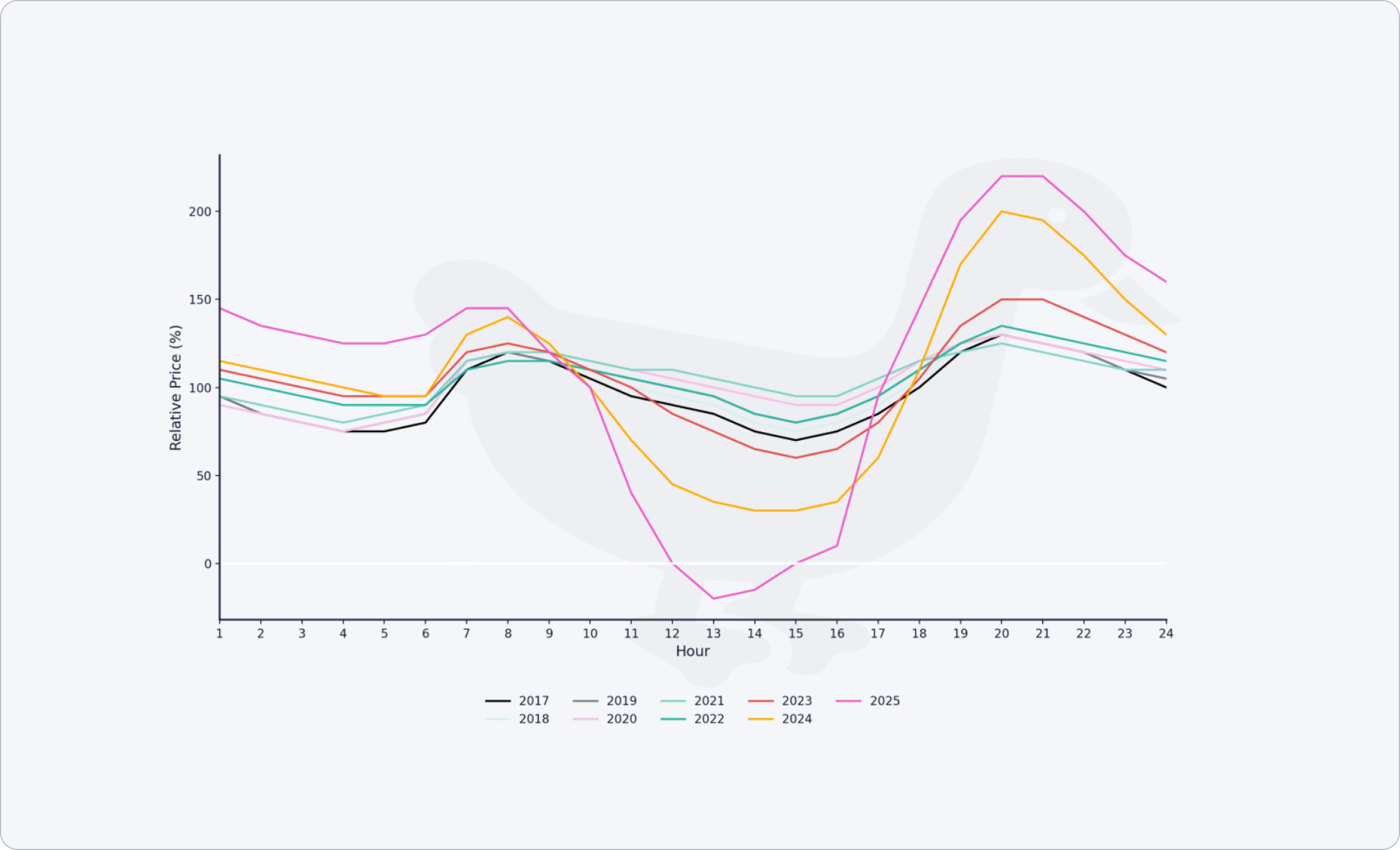
ToU tariffs help address this imbalance by incentivizing electricity use when renewable generation is abundant. For example, in some markets, midday electricity can be relatively cheap due to high solar output, while evening prices rise sharply when solar production drops.
Forward-thinking utilities are now leveraging this dynamic through creative marketing approaches. Some offer tariffs branded as "Free Lunch" (targeting midday solar surplus) or "Happy Hour" pricing (encouraging consumption during specific renewable generation peaks). These consumer-friendly labels make the concept more intuitive and engaging, transforming what could be perceived as complex pricing into tangible, lifestyle-oriented benefits. This approach not only improves customer adoption but also positions utilities as innovative partners in the energy transition rather than traditional commodity suppliers.
By aligning consumption with renewable generation patterns, ToU tariffs support the integration of clean energy and accelerate the transition to a low-carbon energy system.
Compared to traditional flat-rate pricing, Time-of-Use tariffs introduce additional complexity into electricity billing. Instead of applying a single rate to total monthly consumption, usage must be tracked and billed across multiple time periods – each with its own price. While this creates opportunities for savings, it also increases operational complexity for utilities, particularly in legacy billing systems.
This is exactly where many ToU initiatives slow down. Designing the tariff is one thing – accurately billing it, integrating it into existing systems, and scaling it across customer segments is another.
At the same time, differences in energy generation, infrastructure, market regulations, and demand patterns mean that electricity prices – and the savings potential of ToU tariffs – vary from country to country. Yet one constant remains across all markets: the value that ToU optimization can unlock when consumption is intelligently aligned with pricing. The real question is not whether ToU tariffs deliver value, but how to implement them efficiently and deliver that value to end users at scale.
This is where exnaton plays a critical role.
exnaton enables utilities to launch and bill Time-of-Use tariffs without replacing their existing core systems. Built around granular time-series data processing, the platform accurately matches electricity consumption with time-based pricing structures, even across multiple schedules, rate types, seasonal variations, and customer segments.
Utilities can design and deploy tariffs through a user-friendly, clickable front-end interface – defining pricing periods down to the second or minute, creating reusable templates, and assigning them to individual customers or customer groups. This can be done in minutes, without IT support or dedicated project resources. This self-service capability dramatically accelerates time-to-market and empowers business teams to test, refine, and scale new tariff products independently.
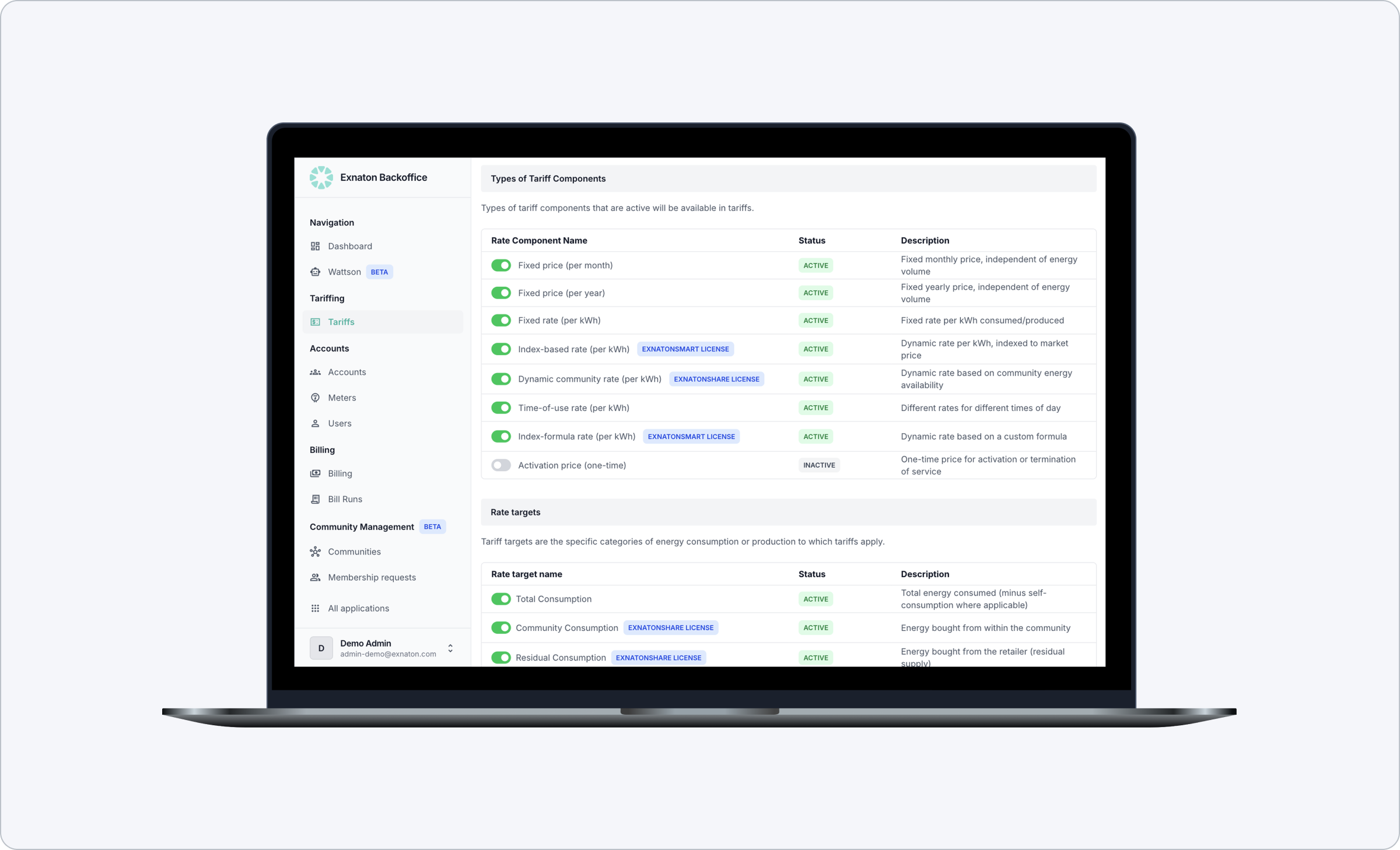
A live coverage panel visualizes the complete week as the tariff is created. Teams can immediately see which hours are covered, identify gaps, and detect overlapping rate components before saving the configuration.
Key capabilities include:
.png)
If tariff components overlap, the editor makes it clear that the corresponding charges will be combined. Gaps are also permitted, enabling utilities to design products that deliberately apply only during selected hours.
This flexibility supports a wide range of products, including happy-hour tariffs, different day and night prices, or tariffs that alternate between fixed and index-based pricing throughout the day. Reusable configurations can be assigned to individual customers or customer groups, helping business teams launch, test, and scale new tariff products without lengthy IT projects.
By acting as a flexible layer on top of existing billing and ERP systems, exnaton removes one of the biggest barriers to ToU adoption: operational and billing complexity. The editor turns tariff creation from a primarily technical configuration task into a transparent workflow in which teams can see and validate their pricing logic as they build.
For end users, this translates into clear, accurate billing based on when and how they consume electricity. When combined with smart technologies such as EV chargers or home energy management systems, consumption can be shifted automatically to lower-priced periods—capturing savings without compromising comfort.
In this way, Time-of-Use tariffs become practical, scalable energy products that utilities can bring to market quickly and customers can benefit from immediately. The improved editor is already available in production.
As energy systems continue to evolve, Time-of-Use tariffs are emerging as a core component of modern electricity pricing strategies – complementary to, rather than replaced by, fully dynamic tariffs. They offer a practical way to balance supply and demand, integrate renewable energy, and empower consumers to take a more active role in the energy system. While dynamic tariffs that reflect real-time wholesale prices appeal to digitally engaged consumers and those with smart automation, ToU tariffs provide a more predictable, accessible option for the broader market. Many consumers prefer the stability and simplicity of fixed time windows over real-time price volatility, making ToU a long-term product in its own right – not merely a transitional step.
For utilities, ToU tariffs enable more efficient grid management and procurement and procurement optimization, while opening up new opportunities for innovative products and services. They also serve as a lower-risk product offering for utilities looking to modernize pricing without exposing customers – or themselves – to the full complexity and variability of wholesale markets. For consumers, they provide a clear pathway to reduce energy costs and participate in the energy transition at a comfortable pace.
Ultimately, Time-of-Use tariffs represent a win-win-win scenario: lower costs for consumers,improved system efficiency and grid stability for utilities and network operators and accelerated progress toward a sustainable energy future.
See how exnaton enables compliant, flexible, and scalable tariff models for modern energy markets.