
Flexibility is moving from a nice-to-have to the backbone of a renewable power system. At exnaton CONFERENCE 2025, oone topic threaded through nearly every conversation: dynamic tariffs and flexibility mechanisms are evolving from pilot projects into foundational elements of the energy system. The drivers are Europe’s accelerating renewable build-out, increasing grid strain and new flexible loads such as electric vehicles (EVs) and heat pumps.
In his keynote, Fabian Stocker, Head of Key Account Management at exnaton, explained why demand-side flexibility matters more than ever, how far adoption of dynamic tariffs differs across Europe and what utilities need to understand to navigate the next five years. This article distils the central insights of his talk.
Europe’s energy transition has accelerated markedly. Denmark now covers more than 80% of its electricity demand from renewables, and Germany has passed the 60% threshold. According to energy think tank Ember, solar generated more electricity than coal in the EU for the first time in 2024 – a milestone for climate action and energy security.
This progress comes with system-level pressure. Solar output peaks at midday; when it coincides with windy periods, generation frequently exceeds demand. Countries such as Germany and the United Kingdom are therefore facing record curtailment costs, now measured in billions of euros a year.
What is curtailment? Curtailment occurs when generators must reduce or stop their output because the grid cannot absorb the electricity produced. It means wasted clean energy and lost revenue for asset operators.
At the same time, wholesale prices increasingly fall below zero during periods of high renewable output. Negative prices mean producers pay to feed electricity into the grid – a clear signal that the system lacks demand-side flexibility.
Grid operators and utilities therefore need instruments that shift consumption towards periods of high renewable availability: grid expansion, battery storage and dynamic electricity tariffs. Among these, dynamic tariffs are the lever most accessible to end customers and therefore the most scalable tool for demand-side management.
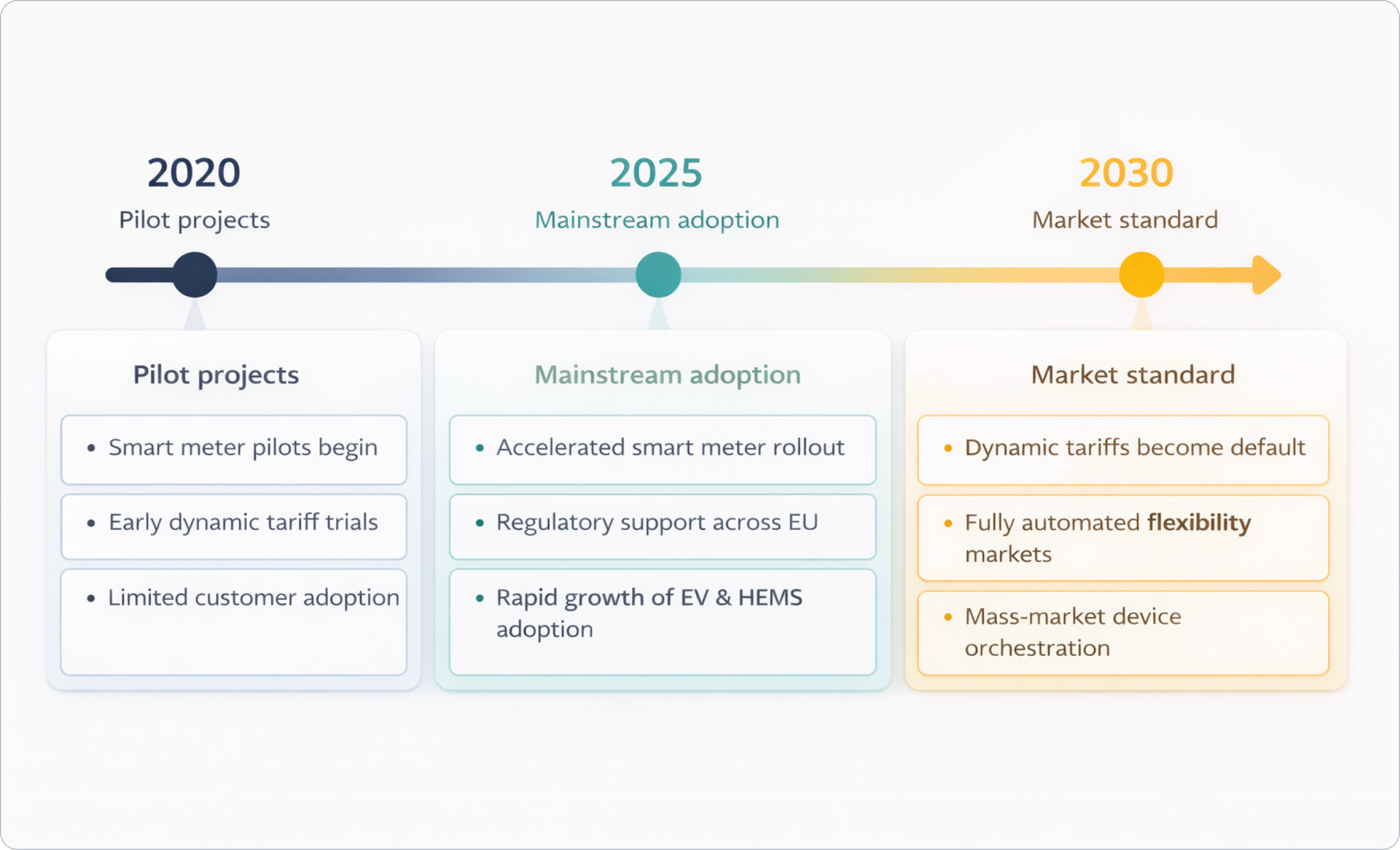
Over the past five years, dynamic tariffs have moved from niche pilots to market products in several European countries. Four factors accelerated this shift.
1. Consumer readiness and acceptance: Consumers have become far more comfortable with dynamic pricing models, particularly EV drivers and heat pump owners who have both the technical flexibility and financial motivation to optimize their electricity consumption patterns. These early adopters recognize that shifting consumption to off-peak hours can result in significant cost savings – sometimes 30-50% compared to standard flat-rate tariffs.
2. Market disruption by neo-utilities: A new generation of energy suppliers, often referred to as "neo-utilities" or "challenger utilities," has used dynamic tariffs to strategically differentiate themselves from traditional market incumbents. These agile companies leverage digital technologies and customer-centric design to create compelling value propositions.
3. Successful commercial validation: Octopus Energy serves as the most visible example of dynamic tariff success. With more than seven million customers in the UK and over one million recently gained in Germany, they have demonstrated that dynamic pricing is not only technically viable but commercially attractive at scale. The company's Agile Octopus tariff, which tracks wholesale electricity prices in half-hourly intervals, has become one of the UK's fastest-growing energy products.
4. Regulatory support: Similar momentum is taking place in markets like Switzerland, where utilities such as Group E, EKZ, and Primeo have announced dynamic tariff launches for 2026, supported by evolving regulatory frameworks that encourage time-variable pricing.
Dynamic tariffs pass changes in wholesale prices, grid load and renewable output on to customers as a price signal. That creates an economic incentive to move flexible loads into the cheapest hours.
Example scenario: On a sunny, windy afternoon when renewable generation is abundant, electricity prices might drop to 5 cents per kWh or even turn negative. That same evening, when millions of households turn on appliances simultaneously while solar generation disappears, prices might spike to 30-40 cents per kWh. Dynamic tariffs pass these price signals directly to consumers, creating strong economic incentives to shift flexible loads to optimal times.
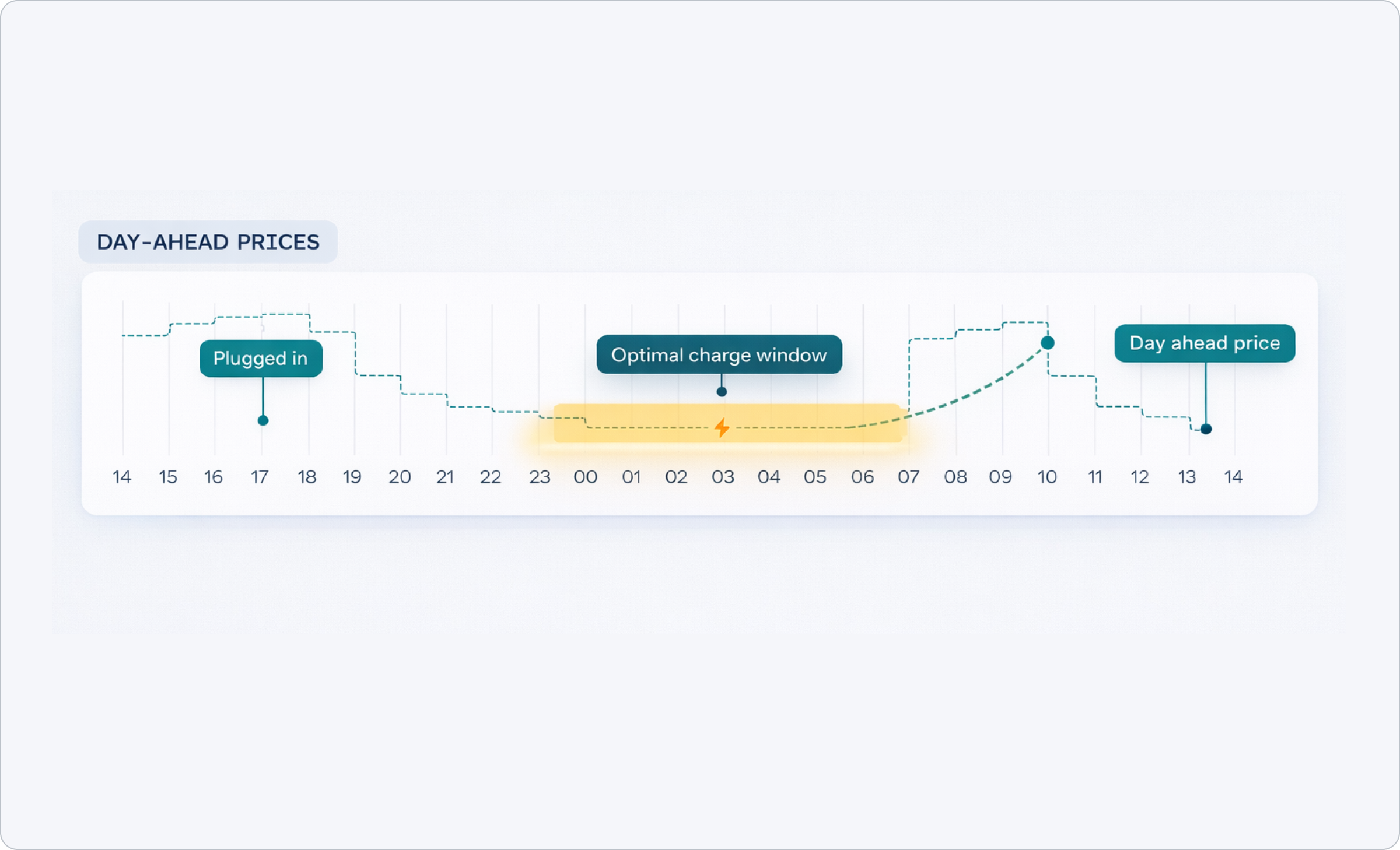
As electrification accelerates – especially through electric vehicle adoption – customers increasingly understand that when they charge matters just as much as how much they charge.
At typical European home electricity prices of €0.20–€0.30/kWh, fully charging a 60 kWh EV battery costs roughly €12–€18, while dynamic or off‑peak tariffs can reduce this significantly when prices drop at night. (How to Estimate EV Charging Cost per Mile in Europe – A Practical Guide)
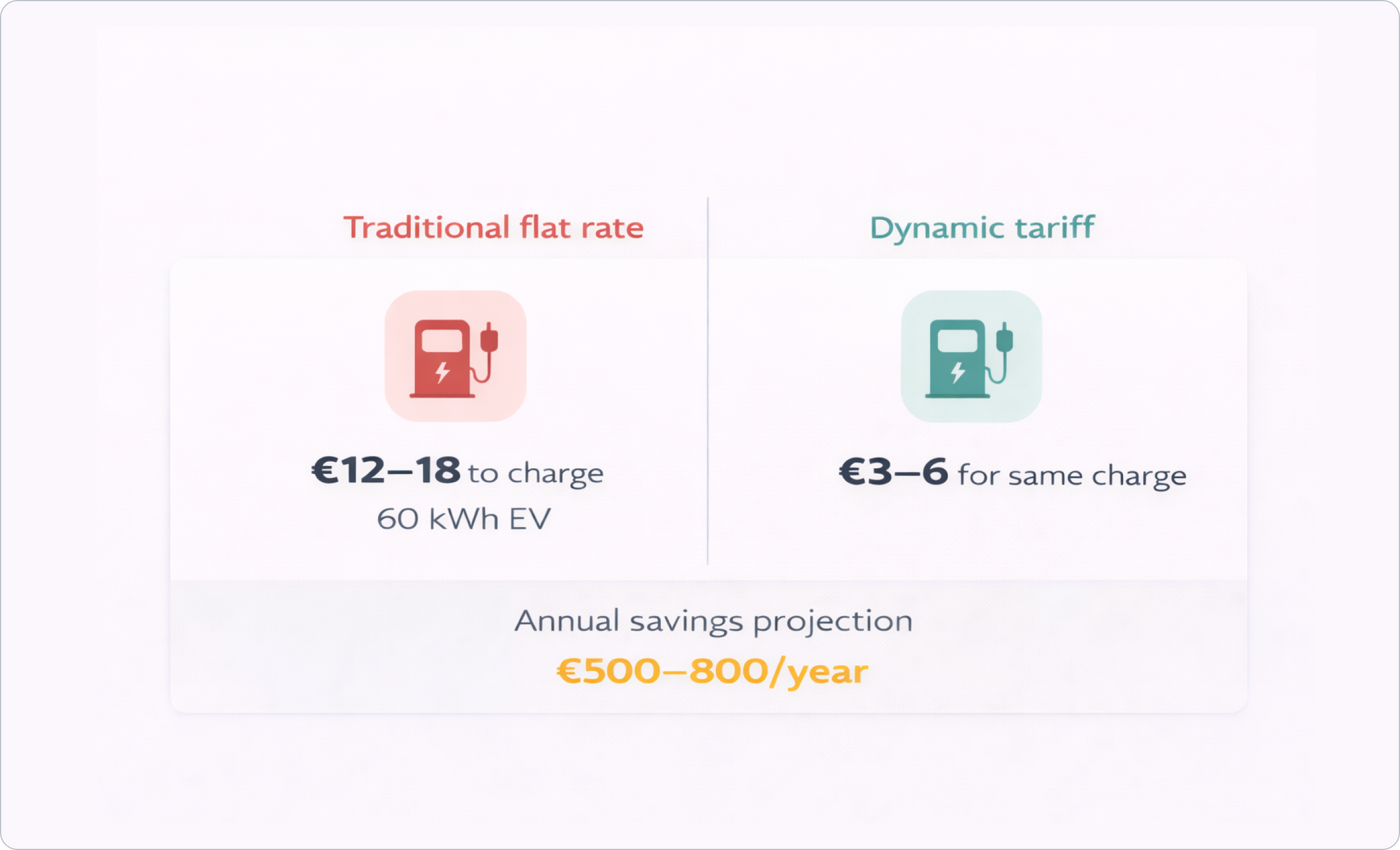
Early adopters appreciate these substantial savings, while utilities benefit from reduced peak loads, improved renewable integration, and more efficient use of grid infrastructure. This creates a win-win scenario that drives adoption on both sides of the meter.
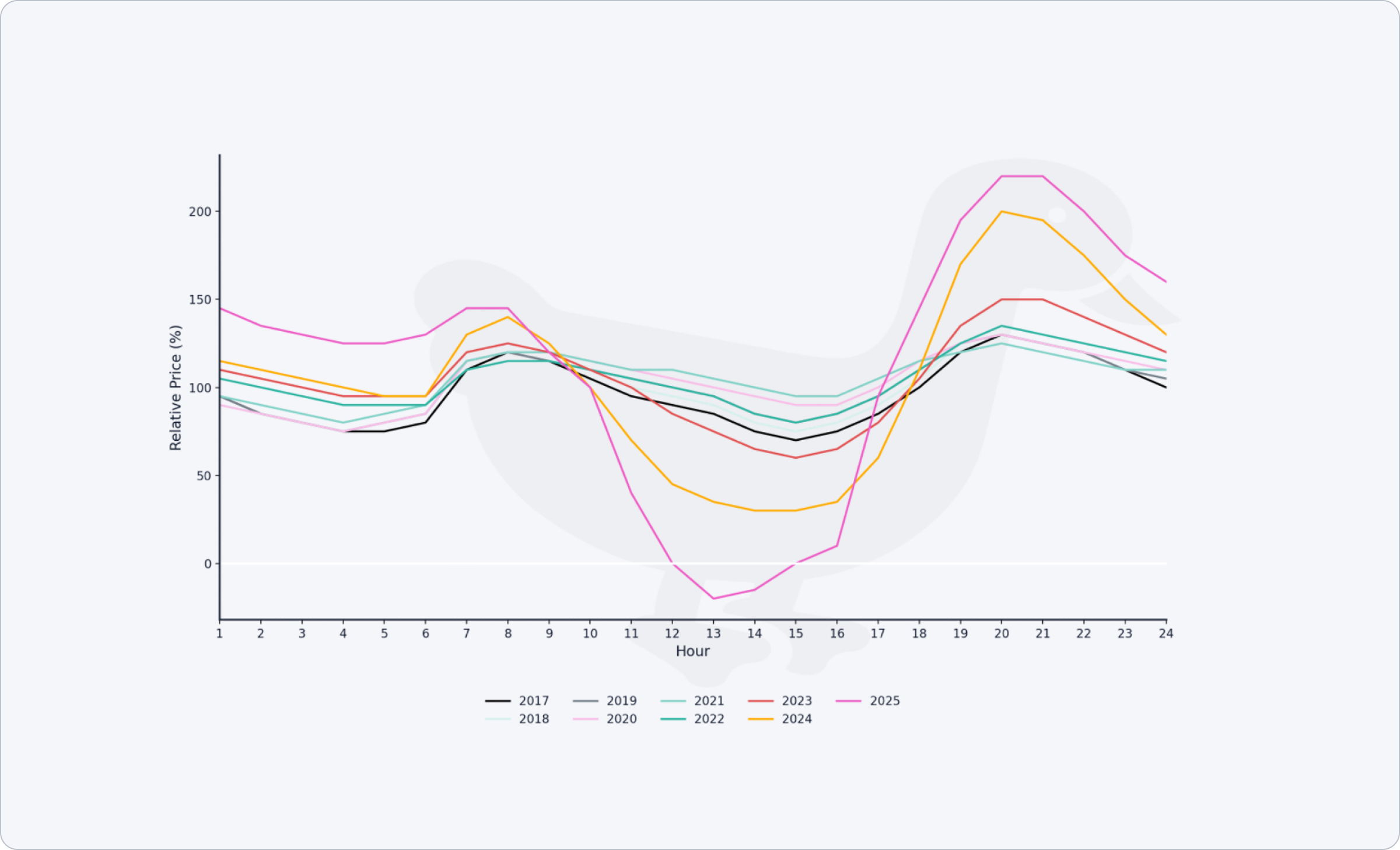
The duck curve shows the widening gap between midday solar generation and the evening demand peak. First described by the California Independent System Operator, net demand – total demand minus renewable generation – forms a duck-shaped curve across the day.
Germany now experiences more than 500 hours of negative electricity prices per year – hours when renewable generation so far exceeds demand that prices turn negative. Spain surpasses this figure by a wide margin, reaching over 600 hours annually. This is not merely a pricing anomaly but a structural consequence of high renewable penetration without sufficient demand flexibility.
Germany recorded 457 hours of negative wholesale electricity prices in 2024, up from 301 hours in 2023, reflecting rising renewable generation and limited system flexibility. In Spain, negative‑price hours surged from zero in 2023 to at least 244 hours in 2024 and more than 500 in 2025, as rapid solar and wind growth outpaced the deployment of flexibility resources.
Analysts emphasize that these negative prices are not a temporary anomaly but a structural outcome of high renewable penetration without sufficient demand‑side flexibility, storage, or grid reinforcements.

Fabian Stocker noted that flexibility mechanisms are the primary lever that prevents the duck's belly from getting even larger. Dynamic tariffs allow customers to shift their consumption to moments when there is abundant renewable electricity, naturally easing pressure on the grid infrastructure. In essence, dynamic tariffs translate the volatility of renewables into actionable price signals that connected devices can respond to automatically.
Traditional approaches to managing electricity grids assumed relatively predictable generation from dispatchable power plants (coal, gas, nuclear) that could be ramped up or down to match demand fluctuations. This paradigm is increasingly obsolete in a renewable-dominated system where generation is weather-dependent and less controllable. The solution requires shifting focus from supply-side flexibility (adjusting generation) to demand-side flexibility (adjusting consumption) – and dynamic tariffs are the primary tool for achieving this shift at scale.
One of the keynote’s key insights: dynamic tariffs are a product category, not a standard product. Utilities should not search for the perfect tariff but build a portfolio that fits different customer types, consumption patterns and flexibility capabilities.
Octopus Energy UK currently offers sixteen different dynamic tariff products, each designed for specific customer segments.
Scottish Power provides ten distinct dynamic tariff variants, while other European utilities are rapidly developing their own portfolios.
These models differ not only in pricing logic but also in the degree to which they integrate various cost components, incorporate risk buffers to protect consumers from extreme price volatility, or target specific customer groups with particular consumption flexibility.
In Germany, this diversity is already visible, albeit still at an early stage, mainly due to the limited rollout of smart meters. Besides the well-known §41a EnWG dynamic energy component, which allows utilities to pass through day-ahead wholesale prices, utilities are starting to introduce time‑of‑use grid fees under §14a EnWG, paving the way for hybrid tariffs that combine wholesale price variation with local grid congestion signals.
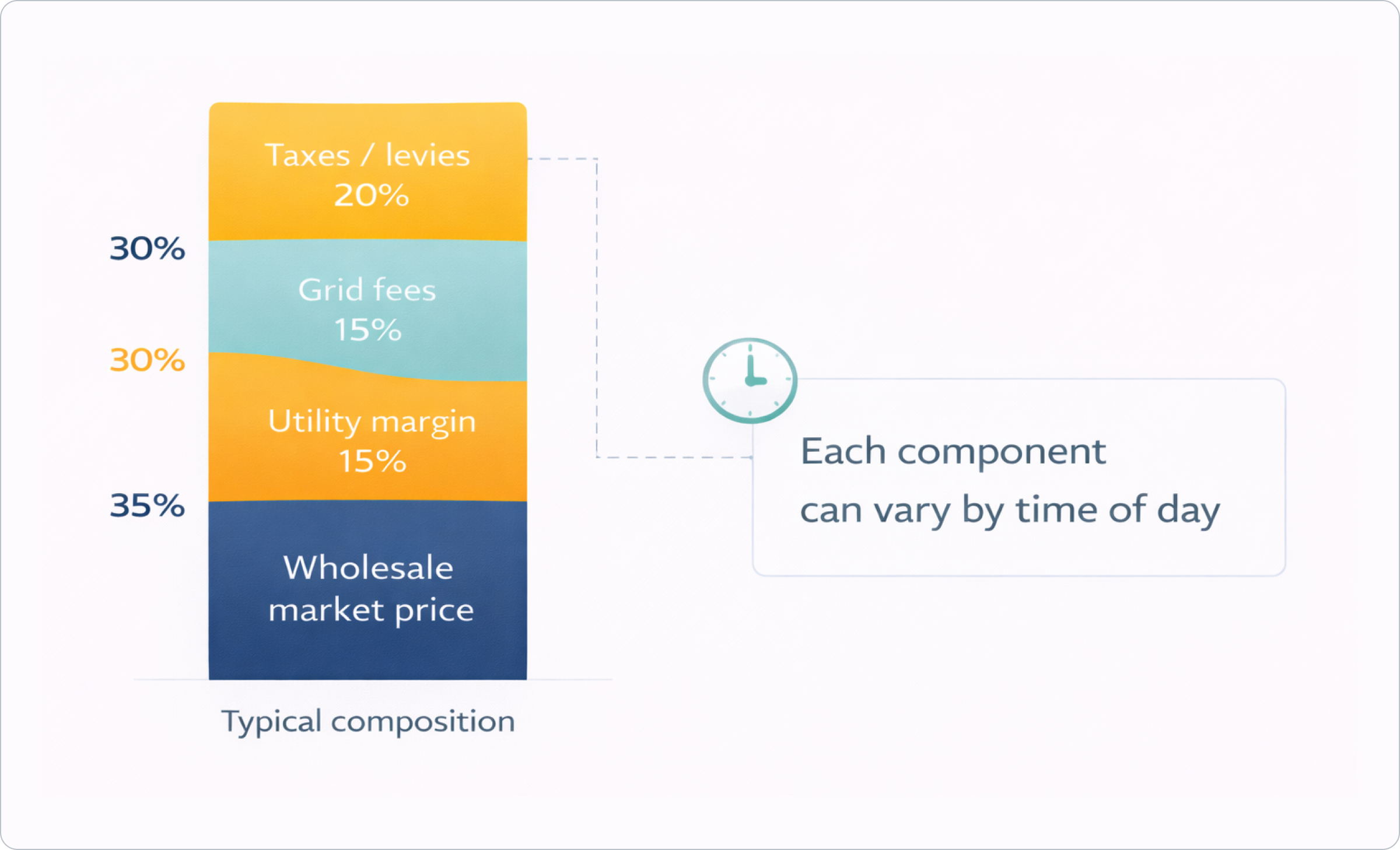
What are grid fees? Grid fees are the charges for using transmission and distribution networks. They typically make up 20–40% of a household electricity bill, depending on grid operator and country. Time-variable grid fees add an incentive to avoid consumption during local congestion.
The slow smart meter rollout is the biggest brake for many utilities: in Germany, almost 95% of customers still cannot be billed on real 15-minute interval data. Waiting for full smart meter coverage delays product innovation by years.
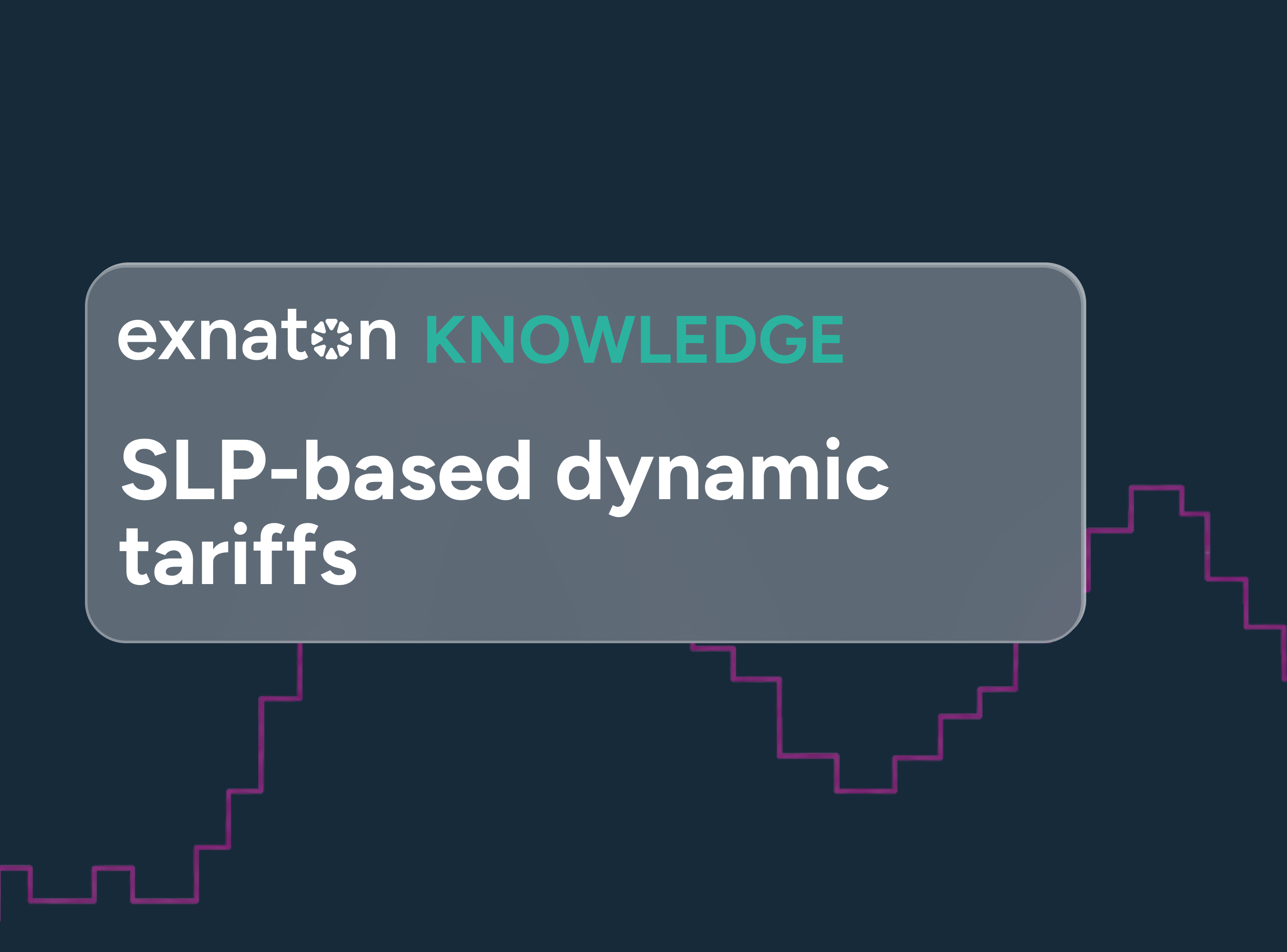
SLP-based dynamic tariffs remove this bottleneck. The billing engine distributes a customer’s estimated consumption across quarter-hours using a standard load profile (SLP) and values it at the corresponding day-ahead prices. Once actual meter readings arrive, consumption is reconciled; when a smart meter is installed, billing switches automatically to measured interval data – without a new contract.
The individual incentive to shift load only comes with interval metering. But utilities gain early operational experience, build a customer base for dynamic products and have the billing infrastructure ready when the rollout catches up. Elli, the energy brand of the Volkswagen Group, runs a single tariff on this principle for customers with and without smart meters.
A common misconception is that dynamic tariffs require customers to check prices constantly and adjust their behaviour by hand. As Fabian Stocker stressed, this behavioural demand response does not scale. A small segment of engaged prosumers – perhaps 2–5% of customers – will optimise manually with enthusiasm. The mass market will not sustain that attention, and even engaged customers tend to tail off after a few months.
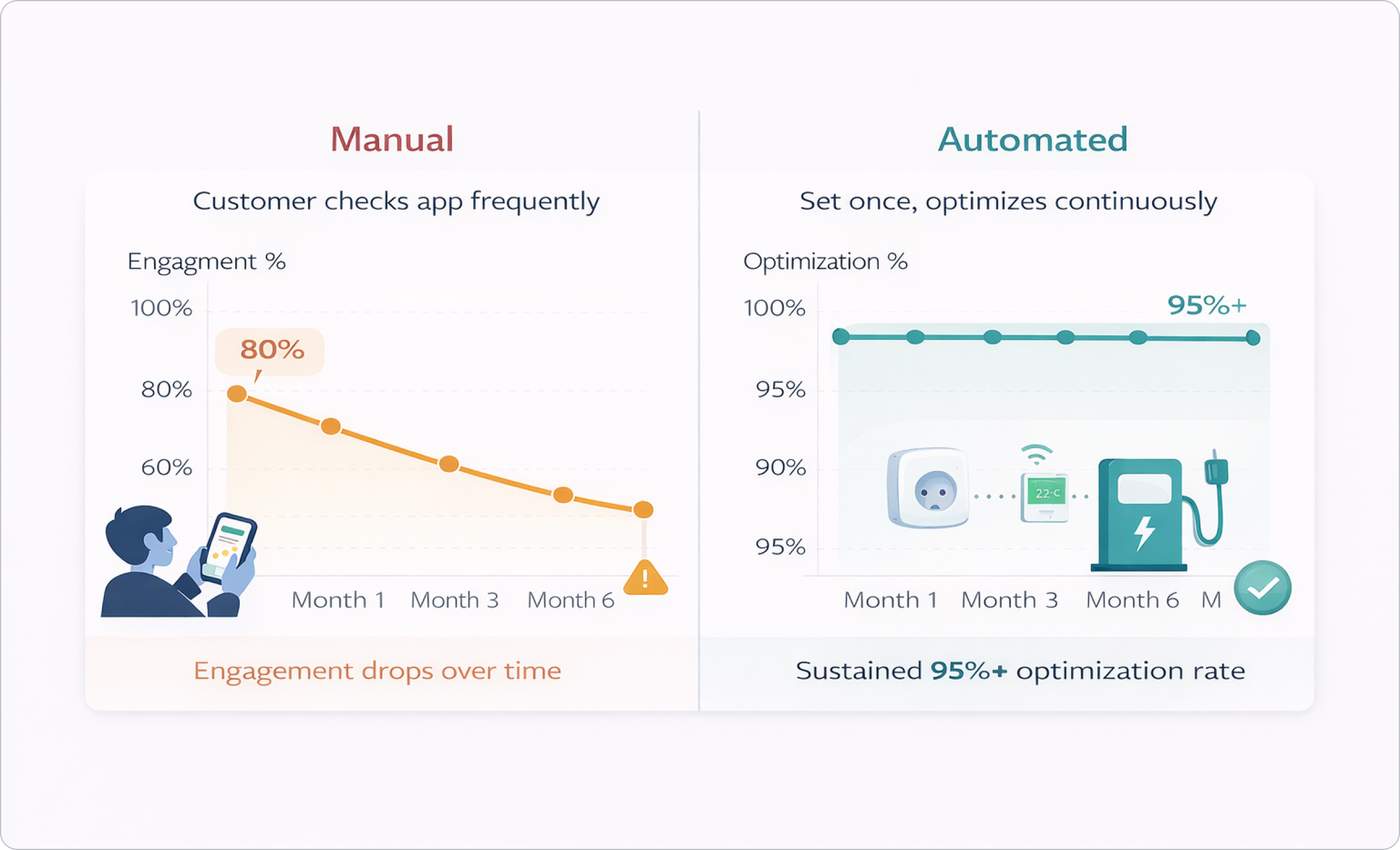
True flexibility at scale emerges only when dynamic price signals are fed directly into connected devices that can respond automatically. These include:
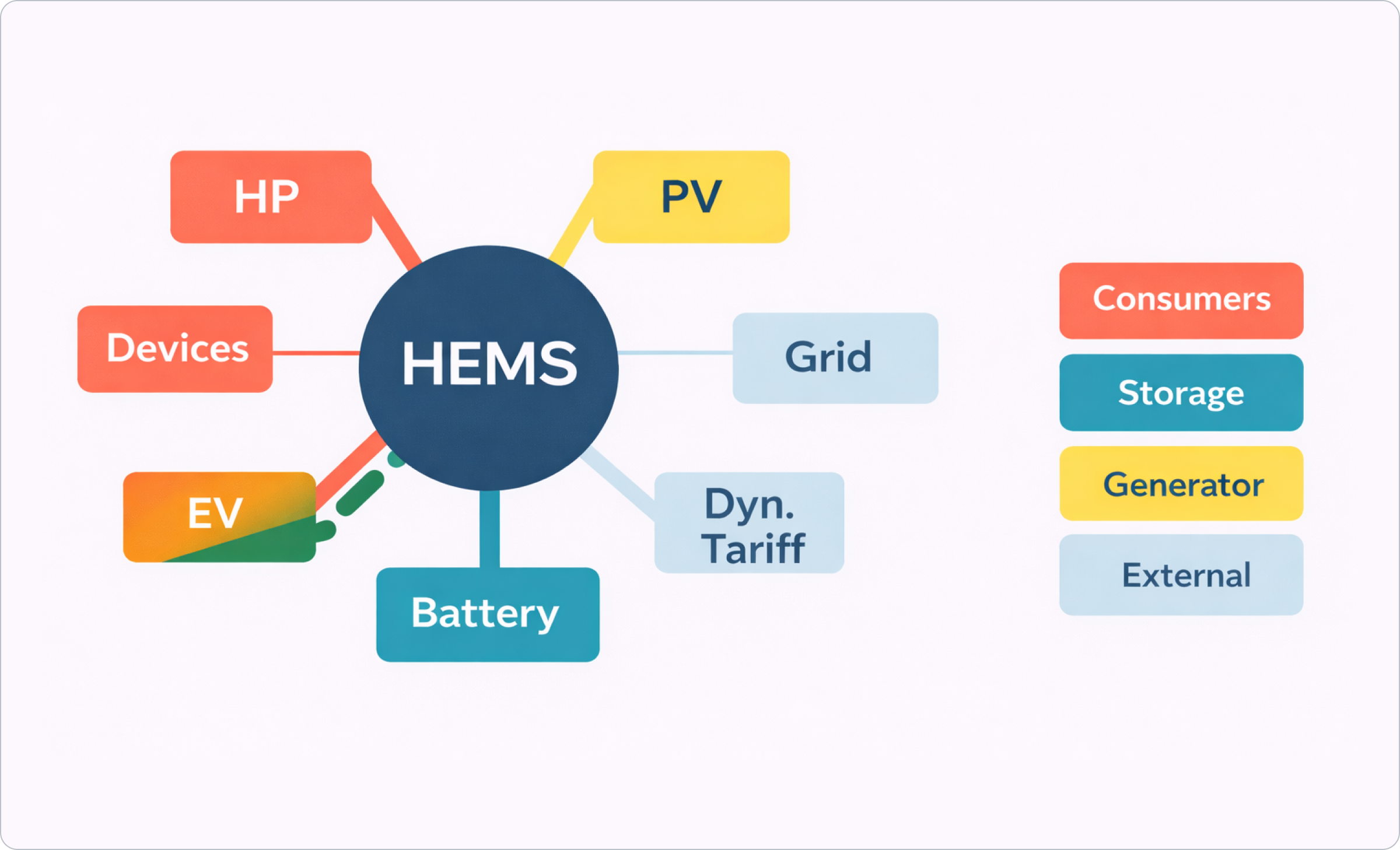
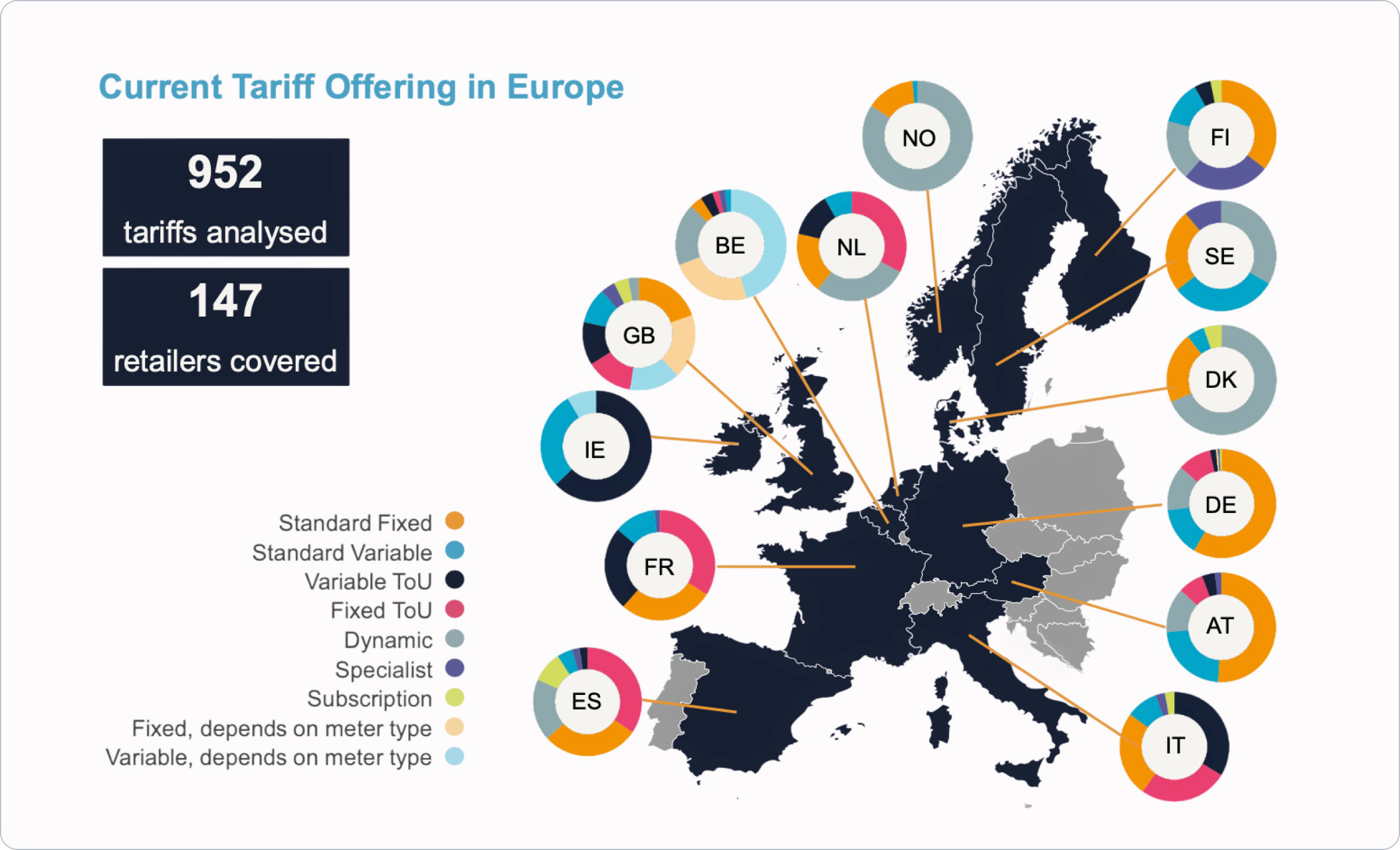
In Norway, Sweden and Finland, dynamic tariffs have been common for more than a decade, and pairing them with automated devices is taken for granted. The same approach is becoming possible in Germany, Austria and Switzerland, supported by the gradual smart meter rollout and interoperable standards such as EEBUS and OpenADR.
“Norway shows that high electrification and high renewables are not a contradiction: they produce fossil fuels, sell them to other markets, and make money, yet their own system runs on almost 100% clean power and almost all new cars are electric. The rest of Europe should simply look north for inspiration instead of losing its way in political confusion.” – Fabian Stocker
Dynamic tariffs are therefore less a customer interface than a data interface. Their value lies in enabling automation and device optimisation. For utilities, this means the audience of a dynamic tariff is not only the customer but also the customer’s connected devices.
Most HEMS today are built to maximise on-site self-consumption, and only some can process day-ahead wholesale prices. That may be enough for pilots. Once tariffs become multi-layered, it no longer is. Future price signals will combine several components:
A device that receives only the wholesale price sees only part of the economic picture. On a windy night, the energy price may be low while the time-variable grid fee is high because of local congestion. If thousands of EVs in one neighbourhood then start charging at once, they can overload the local transformer and trigger grid protection.
The solution is technically achievable: HEMS, chargers and other flexible devices need one unified, all-in price signal that reflects every cost component for that customer, at that location and time. Utilities need a tariff engine that calculates personalised price signals from several data streams and bridges billing systems and customer devices.
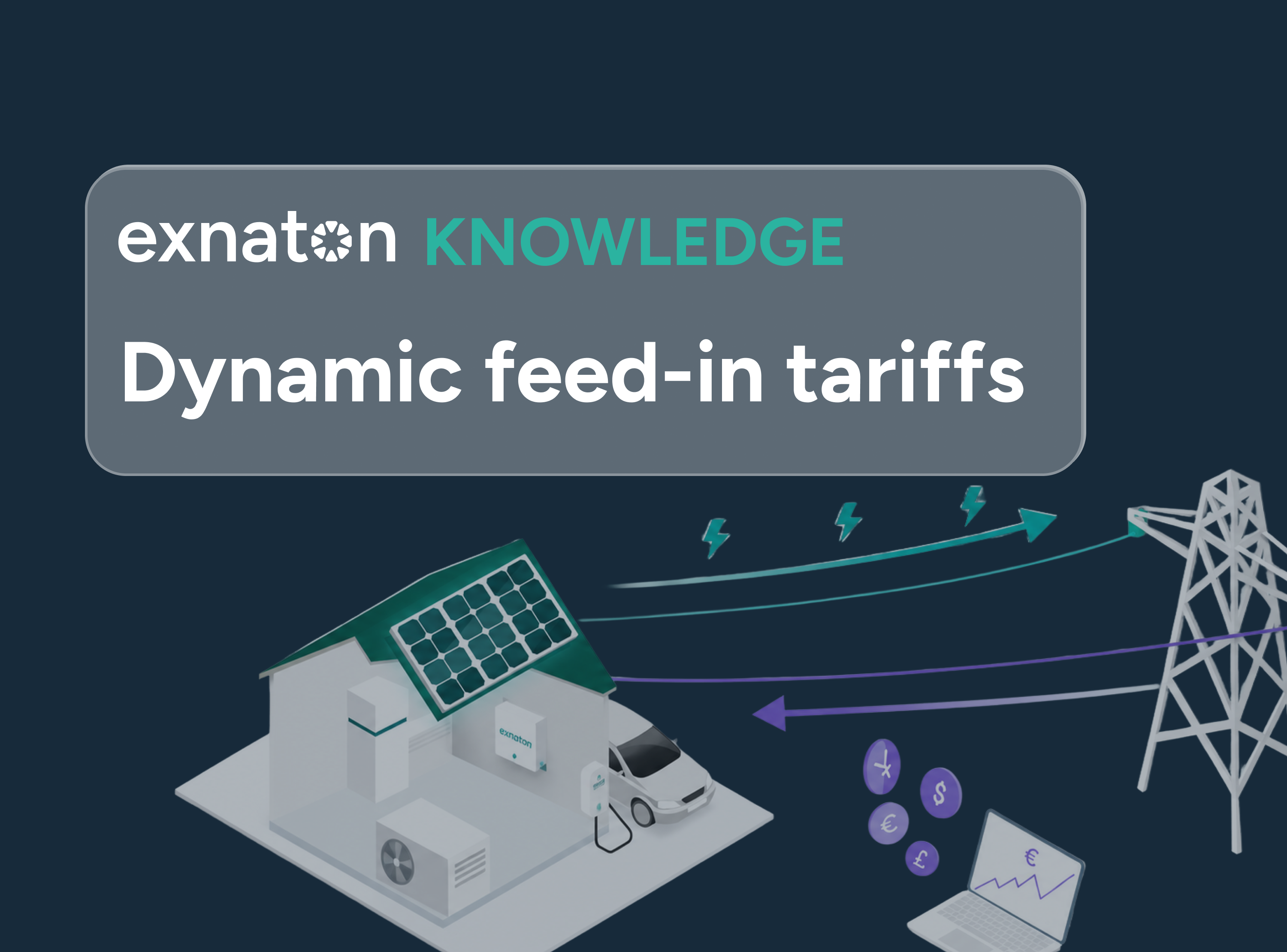
The duck curve’s midday belly is a feed-in problem as much as a consumption problem. Fixed feed-in tariffs pay the same for every kilowatt-hour – and so reward exports precisely when the grid is already oversupplied and prices are negative.
A dynamic feed-in tariff links remuneration to wholesale prices. Combined with a home battery and HEMS, it creates a „lie-in“ effect: instead of charging at the first morning PV surplus, the battery first exports at higher prices and only absorbs power at the midday peak, when it is worth least.
exnaton modelled this for a representative German household with a 10 kWp PV system, home battery, EV and heat pump. Avoiding exports at negative prices alone was worth around €8 in 2025. Steering the battery intelligently on the feed-in side as well delivered an additional benefit of around €100 per year – with no new hardware.
For utilities, the same principle applies as on the consumption side: the price signal has to reach the device. Dynamic feed-in tariffs are a building block for battery-to-grid and vehicle-to-grid products and the basis for future location-specific flexibility offers.
Fabian Stocker showed how this works in a live demonstration with real devices and real tariff data.
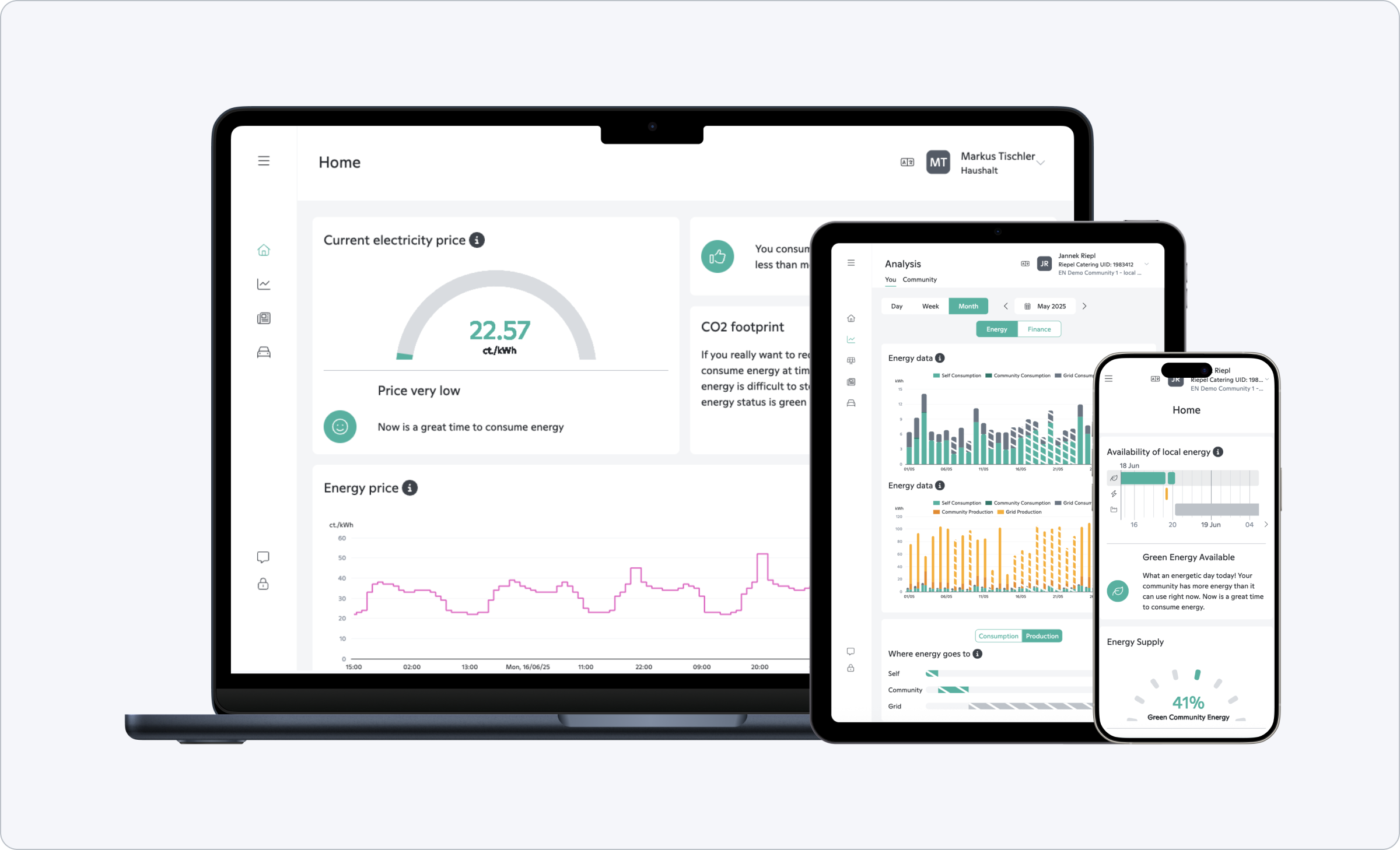
A HEMS was connected to the exnaton platform in seconds and received the full price signal of a customer profile. It then shifted consumption to low-price windows on its own:
An EV was also connected via the manufacturer’s standard login. The driver plugs in, sets a departure time and minimum range – the charging control handles the rest. The technology exists today; the challenges are scaling, interoperability and often lengthy regulatory processes.
Fabian’s conclusion: dynamic tariffs and flexibility products will become an integral part of utility strategy within the next five years. They are no longer experiments but a necessity driven by the physics and economics of renewable power systems. Five capabilities make the difference:
Utilities that wait risk being overtaken by neo-utilities such as Octopus Energy, which are already shaping what customers expect from their energy supplier. Early movers gain operational experience, win the most flexible and engaged customer segments and position themselves as innovators rather than commodity suppliers.
Vehicle-to-grid (V2G). With bidirectional charging, EVs evolve from flexible loads into distributed storage that feeds power back during high-price or congestion periods – with dynamic feed-in tariffs providing the price signal.
AI-powered optimisation. AI-based HEMS and grid software increasingly enable predictive, personalised optimisation that balances comfort with price and grid signals.
Energy sharing and energy communities. [changed] Local models such as energy sharing and energy communities are gaining ground, with dynamic tariffs and local flexibility prices providing their reference signals.
Integration with heat networks. Coordinated control of heat pumps, thermal storage and network operation becomes a key lever for flexibility and decarbonisation.
exnaton supports more than 50 utilities in Germany, Austria, Switzerland and Luxembourg in launching dynamic tariffs and flexibility products quickly – as an intelligence layer on top of existing billing systems, without replacing the ERP. How tariff models, billing and device connectivity work in detail is explained on our page on dynamic electricity tariffs for utilities. For a broader market view, see our whitepaper “Flexibility, Dynamic Tariffs & Energy Sharing: How 2025 Transformed the Energy Market — and What 2026 Means for Utilities” .
The transition to renewable power systems is well underway across Europe. Dynamic tariffs and automated flexibility are the most scalable way to balance supply and demand – on the consumption side and on the feed-in side. For utilities, the question is no longer whether to offer dynamic tariffs, but how quickly they can build the capabilities to do so effectively.
Planning to launch dynamic tariffs or flexibility products? Talk to us – we’ll show you how it can work for your customer base.
Negative prices occur when generation exceeds demand – typically at midday with high solar and wind output. Because many plants cannot curtail flexibly, producers pay to keep feeding in. Germany saw around 575 such hours in 2025.
The duck curve shows net demand – total consumption minus renewable generation – across the day. It dips sharply at midday and rises steeply in the evening. The more solar in the system, the deeper the belly and the steeper the evening ramp.
Demand-side flexibility means shifting electricity consumption in time to match generation and grid load – for example charging EVs in cheap hours or pre-heating with heat pumps. In the mass market, this works mainly through automation via HEMS and connected devices.
The wholesale price reflects only the national market. Grid fees, supplier markups and local congestion are missing. Devices that react only to the exchange price may charge uneconomically and add strain to local grids.
Yes. With SLP-based dynamic tariffs, utilities can start today and switch automatically to interval billing once a smart meter is installed. Learn more in our article on SLP-based dynamic tariffs.