
Energy suppliers receive more granular and diverse data than ever before – from distribution system operators, smart meters and market platforms to charging stations, photovoltaic systems, batteries and other connected assets. Yet receiving data is not the same as being able to use it.
Energy Data Management (EDM) covers the collection, organisation, validation and processing of this data. A modern EDM turns fragmented inputs into consistent, usable time series for forecasting, procurement, billing and reporting. An Energy Data Hub takes this further by connecting multiple data sources, adding context and making the information available for analytics, automated workflows and new energy products. It becomes the operational data layer between metering and market data on one side and ERP, billing, trading and customer-facing systems on the other.
This evolution is becoming increasingly important as solar panels, electric vehicles, heat pumps and battery storage reshape consumption and generation patterns. At the same time, dynamic tariffs and flexibility services place new demands on the underlying data infrastructure.
At exnaton, we see the future of energy data management as an intelligent Energy Data Hub: a shared platform that connects energy data, enriches it with context and turns it into action, providing a reliable foundation for energy products and decisions across the business.
An energy data management system, or EDM system, is software that organises and processes energy data. This includes meter readings, load profiles, and consumption and generation time series. The system prepares this information for use in energy industry processes.
Typical EDM functions include:
To perform these tasks, an EDM system typically combines data interfaces, time-series management, validation and calculation functions, and reporting tools.
The required capabilities depend on the market role, country and processes involved. An electricity supplier has different requirements from a distribution system operator or metering operator. Regulatory responsibilities remain with the relevant market participant; the software supports their fulfilment.
Energy suppliers increasingly need a data foundation that combines metering data with information about connected devices, consumption patterns and flexibility. Data management focused exclusively on established industry processes addresses only part of this need.
A meter at the grid connection point shows how much electricity a household imports or exports. On its own, however, it does not explain how much an electric vehicle consumes, when a battery charges or how a heat pump affects the household’s load profile.
Additional data from charging points, inverters and home energy management systems can reveal these relationships. Access depends on suitable interfaces and the necessary permissions to use the data.
This expands the question from “How much energy was measured?” to “What explains this pattern, and what useful action could follow?”
An Energy Data Hub is a central platform that brings together energy data from multiple sources, adds context and makes it accessible to different applications. In exnaton’s vision, it connects data management with analytics and support for automated workflows.
Potential data sources include:
Data provenance, timestamps and quality must remain transparent. Frequently updated device data may support operational analysis, while billing must use the applicable metering data and follow the relevant process requirements.
An Energy Data Hub preserves these distinctions and provides appropriate information for each use case.
The terms overlap. Modern EDM systems may already integrate multiple data sources, support forecasting and provide information through APIs. The actual capabilities matter more than the label.
Our vision of an Energy Data Hub broadens the focus of energy data management:
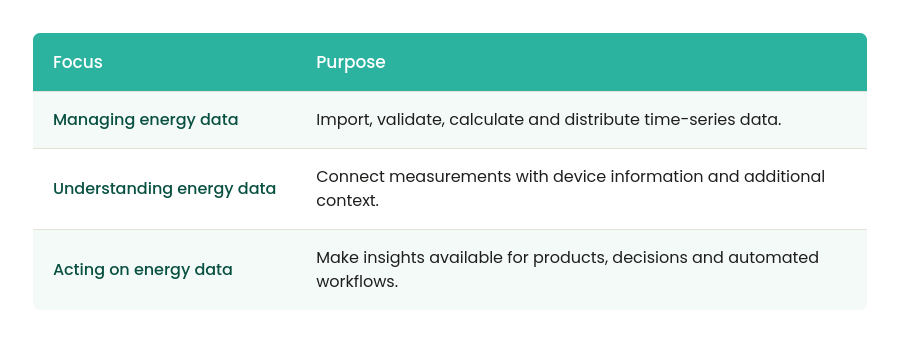
Missing consumption values can delay billing and other downstream processes. An intelligent hub should identify these gaps and show which processes are affected.
In our vision, it would then trigger an appropriate data request through a connected energy market communication system and track its progress. AI agents could help classify issues and initiate follow-up actions within defined rules. Cases requiring judgement would be passed to employees.
This makes data quality an ongoing operational process. It cannot guarantee that missing measurements become immediately available, but it can ensure that gaps are identified and their resolution is actively managed.
Households with heat pumps have different consumption patterns from those with electric vehicles or solar panels. These differences can matter for forecasting and energy procurement.
An Energy Data Hub can provide the foundation for analysing these groups and combining their consumption or generation profiles with additional information. Forecasts built on this foundation could account for weather conditions or changes in the composition of the customer portfolio.
Our vision is to make these insights available to procurement, product management and other business teams.
A more detailed understanding of consumption and generation can help suppliers develop relevant customer offers.
Regular solar export peaks may justify assessing the value of battery storage. Recurring charging patterns may indicate which customer groups could benefit from a time-of-use tariff. Information about connected devices can support the evaluation of potential flexibility services.
Whether these insights lead to a commercially viable offer or a specific device control action depends on technical capabilities, customer agreements and applicable market conditions.
A shared data foundation makes information easier to use across applications and departments.
A customer portal needs consumption histories. A document generation system may request recent meter readings or monthly consumption totals. Procurement needs aggregated time series. Employees need to explore customer and portfolio trends in a back-office interface.
In our vision, the Energy Data Hub provides this information through clearly defined APIs and suitable visualisations. New applications can then build on a common data foundation.
exnaton already connects granular energy data processing with tariff logic, billing and visualisation. These capabilities provide important foundations for the evolution towards an intelligent Energy Data Hub.
Our platform supports applications including dynamic electricity tariffs and energy sharing models. Time-resolved consumption, generation and price data are used to operate and bill real energy products. Interfaces enable integration into existing IT environments.
This connection between energy data and its commercial use shapes our development approach. Data should be available where suppliers design products, operate processes and make decisions.
Our broader vision builds on these foundations. Additional data sources, customer-group forecasting and agent-assisted workflows describe the direction of development. For each use case, the available functionality and any required extensions or integrations need to be assessed specifically.
In our view, the future of energy data management lies in connecting reliable data, meaningful context and practical action.
The traditional responsibilities of an EDM system remain necessary. However, a system whose value ends with storing and distributing time series will find it increasingly difficult to meet expanding business needs.
For energy suppliers, the strategic question is how effectively their data foundation enables new products, connects teams and improves day-to-day operations. This is the direction in which exnaton is developing its platform: as a partner for energy businesses that want to create value from their data today while preparing for future applications.
Would you like to use your energy data for new products and smarter workflows? Talk to exnaton about how your existing IT landscape could evolve towards an Energy Data Hub.
EDM stands for energy data management. It covers the collection, organisation, validation and processing of energy data for activities such as billing, forecasting and energy balancing. An EDM system provides the software capabilities to support these tasks.
An Energy Data Hub can complement an existing EDM system. Whether it can replace particular functions depends on its capabilities and the requirements of the relevant market role. A hub does not automatically fulfil every required EDM or energy market communication process.
An Energy Data Hub can be designed to process real-time or near-real-time data. Actual data freshness depends on the source, interface and transmission interval. Data received through energy market processes may arrive at a different frequency from data collected directly from connected devices.
AI can support anomaly detection, forecasting and repetitive operational tasks. In exnaton’s vision, AI agents could help determine appropriate follow-up actions when data issues are detected and initiate those actions within defined rules.
exnaton currently provides capabilities for processing, billing and visualising energy data. This does not imply a complete EDM feature set for every market role. The Energy Data Hub describes a vision for extending these foundations with additional data sources and intelligent workflows.