
Structured B2B Energy Contracts and PPAs
Vermarkte komplexe B2B-Stromprodukte profitabel – SPOT, Tranchen, PPAs oder als kombinierte strukturierte Verträge.Automate energy allocation, calculation of billing values, visualization, and customer reporting. All without replacing your existing ERP or billing system. Supported by AI agents.


Trusted by 50+ utilities


Tranches, PPAs and Spot for every B2B customer structure

Launch structured B2B energy contracts without building custom software
Offer innovative products without lengthy IT projects:
Spot products including price caps and floors
Tranche-based procurement alongside EPEX SPOT market purchases
Include on-site, and off-site PPAs
Contracts for single site as well as multi site customers
Pay-as-produced or pay-as-consumed settlement
Fixed-price or dynamic (spot-indexed) pricing
Different tariffs for different members of the same contract
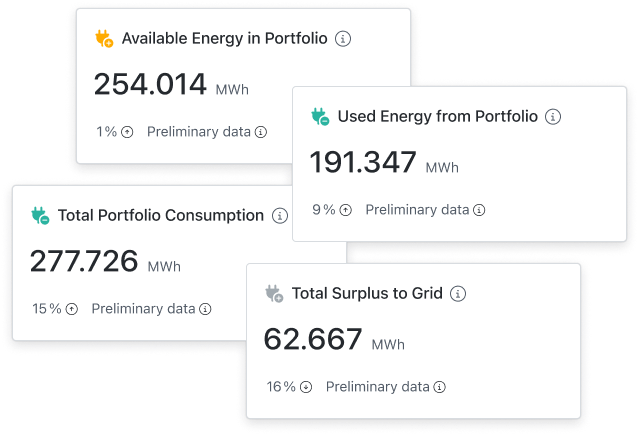
Deliver the transparency business customers expect
Improve business customer satisfaction and strengthen retention by providing detailed visibility into:
Self-consumption rates
PPA, Tranche and Spotmarket contribution
Surplus sold back to the spot market
Costs and revenues per site
ESG sourcing data

Future-Proof Your Energy Business
Create the foundation for:
Commercial Energy Management Systems (CEMS)
Flexible load optimization
Battery storage integration
EV charging optimization
Everything required to operate complex B2B energy contracts
Configure and manage:
Fixed-price Tranches and PPAs
Dynamic-price PPAs and Spotmarket Residual load
Price caps and price floors
Time of use prices
Pay-as-produced contracts
Pay-as-forecasted contracts
Wind PPAs
Solar PPAs
Onsite and offsite
Multi-asset portfolios
Automatically allocate generation and consumption volumes across:
single Sites
Multiple sites
Balancing groups
Customer portfolios
Support hierarchical, dynamic, proportional, and custom 15 min allocation logic.
Automatically calculate:
PPA consumption volumes
Residual demand from EPEX SPOT
Long positions
Short positions
Tranche consumption volumes
Surplus volumes sold to the spot market
Imbalance energy costs
Support customers with:
Balancing group model for business customers, but also municipalities and housing associations
Distributed generation assets – on-site and off-site
Wind and solar
Distribution of surplus to other sites
Flexibility in the pricing model
Connect seamlessly to existing systems. exnaton calculates billing-ready items and transfers them automatically into:
SAP IS-U
SAP S/4HANA
Other ERPs such as powercloud
No costly replacement projects required
Go live within 3 months
Provide stakeholders with:
Portfolio / energy contract performance tracking
Consumption and generation insights
Sourcing breakdowns
Cost transparency
Self-consumption KPIs
ESG reporting data
Available via a dedicated portal or embedded directly into existing customer platforms.
Connect energy contract pricing signals directly to:
Commercial EMS
Smart charging systems
Battery storage
Built for utilities serving commercial and industrial customers
Ideal for
✓ Utilities offering any type of time series based energy contracts for B2B customers including PPA multi site energy sharing
✓ Municipal utilities
✓ Energy service companies or B2B companies with retailer market roles (ESCOs)
Ready to commercialize B2B energy contracts without operational complexity?
See how utilities automate allocation, settlement, visualization and billing for even the most sophisticated renewable procurement models – all while keeping their existing billing systems.
Frequently asked questions
What types of B2B energy contracts does exnaton support?
For B2B customers from utilities exnaton supports stand alone or structured combined dynamic tariff contracts, Tranche modes and PPAs. For single and multi site customers.
What types of PPAs does exnaton support?
exnaton supports on-site and off-site PPAs, physical and virtual PPAs, pay-as-produced and pay-as-forecasted contract models.
Which pricing mechanisms does exnaton support?
Exnaton supports fixed, dynamic and time of use pricing structures, as well as price caps and price floors.
Can exnaton handle PPA products combined with tranche and spot procurement?
Yes. exnaton automatically combines PPA volumes with spot market purchases and tranche products while managing long and short positions and balancing residual demand.
Does exnaton replace our existing billing system?
No. exnaton acts as a specialized pre-billing and allocation engine. Billing-ready items are automatically transferred into your existing ERP or billing system for final invoice generation.
Can customers see how much electricity comes from PPAs, Tranches and Spotmarket?
Yes. exnaton provides detailed visualizations showing the composition of electricity supply, including PPA volumes, spot market purchases, Tranche volumes, self-consumption rates, costs, and revenues.
How long does implementation take?
Most utilities can go live within 12 weeks, depending on the complexity of integrations and product configuration.
Can exnaton manage structured energy contracts across multiple customer sites?
Yes. exnaton is specifically designed for complex B2B use cases, including customers with multiple sites, subsidiaries, balancing groups, and energy sharing from renewable generation assets (PPAs).
What business outcomes can utilities expect?
Utilities can reduce operational costs, improve margins, and scale complex B2B energy products without increasing manual effort. Automated billing also enables faster customer onboarding, reduces errors and operational risk, and strengthens customer retention through greater transparency.
Does exnaton support pay-as-produced and pay-as-consumed contracts?
Yes. exnaton supports both pay-as-produced and pay-as-consumed PPA models, as well as fixed-price, dynamic-price, physical, virtual, on-site, and off-site PPAs. The platform automatically allocates generation and consumption volumes according to the agreed contract logic and combines them with tranche and spot market procurement where required.
Can customers access ESG and renewable sourcing data?
Yes. exnaton provides customer dashboards and visualizations showing renewable energy sourcing, PPA, and Tranche contribution, self-consumption rates, spot market volumes, costs, revenues, and ESG reporting data. This gives commercial customers full transparency into how their electricity is sourced and settled, helping them meet sustainability reporting requirements.
Does exnaton integrate with SAP IS-U and SAP S/4HANA and any other ERP system?
Yes. exnaton integrates seamlessly with existing ERP and billing environments, including SAP IS-U and SAP S/4HANA. Rather than replacing your core billing system, exnaton acts as a specialized pre-billing and allocation engine, automatically transferring billing-ready items for invoice generation.
Can exnaton support cross-site self-consumption and B2B energy sharing?
Yes. exnaton is designed for complex multi-site energy products. The platform supports cross-site self-consumption, corporate energy sharing, municipalities, multiple facilities, subsidiaries, and distributed renewable generation assets. It automatically allocates locally generated electricity across sites according to configurable allocation rules, enabling scalable B2B Energy Sharing and multi-site PPA models.