
AI agents do more than help utilities answer questions. They can analyse data, bring together information from different systems and independently carry out clearly defined tasks.
They are particularly well suited to processes involving high levels of manual effort, recurring decisions and numerous exceptions, for example, resolving billing exceptions, explaining bills or monitoring regulatory changes.
This opens up new opportunities for utilities to reduce the operational workload, make better use of existing expertise and scale complex processes. However, the capabilities of the underlying AI model are not the only factor that matters. A language model becomes an agent that can be used productively only when it is equipped with domain expertise, controlled system access and clear guardrails.
In conversations with more than 20 utilities across the DACH region and France, four challenges emerged repeatedly:
Data protection, data sovereignty and data security are essential foundations for every AI use case. They are not an afterthought but must be incorporated into the technical and organisational design from the outset.
Interestingly, AI does not always require perfect data from the beginning. When used correctly, it can help identify data issues, verify relationships and gradually improve data quality.
An AI agent is a software system that pursues a defined objective, evaluates information, makes decisions and uses approved tools to perform actions. On its own, a language model merely generates a response based on an input. It becomes an agent capable of carrying out tasks within a company only when it is embedded in an additional technical and domain-specific environment.
In particular, it requires three things:
The value therefore does not come solely from the underlying AI model. What matters is how effectively the agent is equipped with domain expertise, system access and control mechanisms. The latter is precisely where we focus our efforts at exnaton.
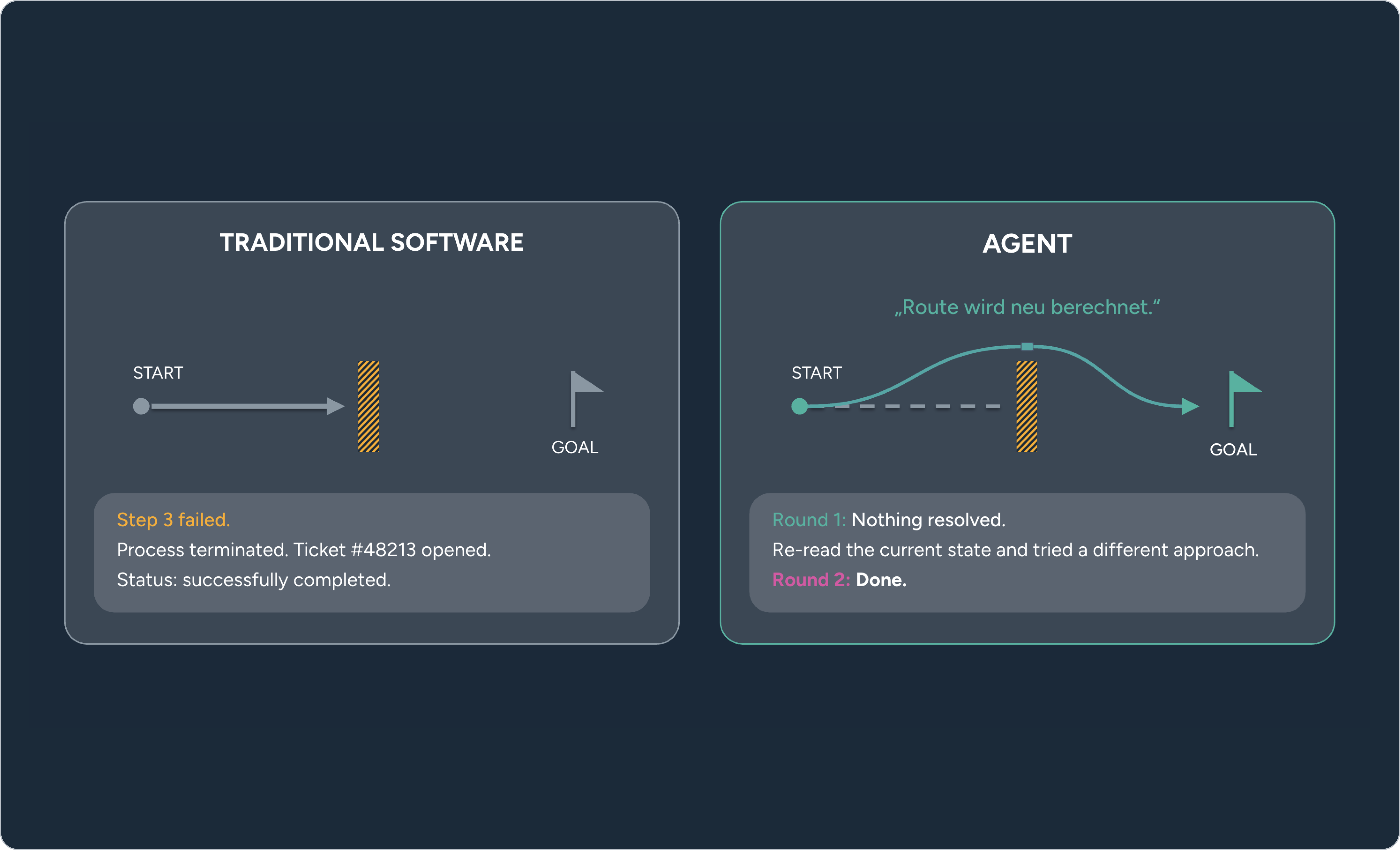
Traditional software follows predefined workflows: step one is followed by step two, and then step three. If one step fails or an unforeseen situation arises, the process often ends with an error message or a manually created ticket.
An AI agent, by contrast, is oriented towards a specific objective. It can assess the situation, select an appropriate next step and try a different approach if necessary. If a request is rejected or information is missing, it can reassess the case, consult additional data or escalate it to a human in a targeted manner.
This makes agents particularly useful for processes involving numerous variations, exceptions and incomplete information. They do not necessarily replace existing systems. Instead, they work across these systems and connect information that previously had to be brought together manually.
Complex tasks do not need to be handled by a single agent. Multiple specialised agents can collaborate: one analyses the data, another evaluates the results and a third performs an action once approval has been granted.
This principle resembles collaboration within a human team. Specialists also open several systems, compare information, apply their expertise to the individual case and ask for clarification when uncertain. The more relevant systems an agent can securely incorporate, the more comprehensively it can identify relationships and process tasks.
Humans remain a central part of the process. Through a human-in-the-loop approach, the agent can submit decisions for review, receive feedback and learn from it for comparable cases. As its quality and reliability improve, its level of autonomy can gradually increase from making recommendations, to performing actions that require approval, and ultimately to independently completing clearly defined tasks.
The challenges identified above suggest three particularly relevant groups of use cases.
An AI-powered customer advisor can analyse energy and billing data and turn it into clear, understandable information for sales teams, customer service representatives or end customers.
One example is a bill explainer: customers upload their bill and receive an easy-to-understand explanation of the individual items. They can then ask specific questions in natural language, for example, when the most expensive hour occurred during the billing period or how a dynamic tariff affected their costs. You can try our prototype here.
Additional applications are possible when load profile data is available. The agent can recommend suitable tariffs or products, explain anomalies or identify opportunities for additional offers. Particularly interesting are the devices a customer does not yet own. For example, a load profile might indicate that a customer has a PV system but no air-conditioning system, even though one could make effective use of the solar generation. It could also reveal that the customer does not yet own an electric vehicle or, if they do, that their consumption is not yet particularly flexible. These insights can create real value for sales teams.
Product development in the energy market requires the continuous monitoring of regulatory changes, market trends and internal product specifications. A product assistant can bring this information together, highlight relevant deadlines and identify potential effects on existing products.
For example, it could determine which tariff components need to be adapted due to new regulatory requirements, evaluate ideas for new products or recommend specific changes to the product management team. This not only reduces the research workload but also helps utilities incorporate new developments into their product planning earlier.
The potential is especially significant in the handling of billing exceptions. Missing energy data, inconsistent master data or market messages that have not been processed completely often prevent accounts from being billed on time. Resolving these cases requires specialist expertise, research across multiple systems and numerous recurring individual steps although their sequence and other details may vary slightly from case to case.
A billing-exception agent can first identify which accounts cannot be billed, analyse the causes and initiate appropriate measures. For each customer account or metering point, it can check data from different sources, search for or request market messages again, and later verify whether a response has been received. In this way, it also learns which actions succeed in which context and which do not. Only cases it cannot resolve independently are escalated to a specialist, together with all the context already collected.
This use case clearly demonstrates why agents go beyond traditional automation. They do not merely execute a predefined sequence of steps; they pursue a clear objective: making as many accounts as possible billable as quickly as possible.
It is particularly important for utilities that AI agents do not require a complete overhaul of their existing IT landscape. They can complement existing ERP, billing, market communication and data systems, provided that appropriate and secure access is established.
The integration of SAP Joule with exnaton agents illustrates how this can work. Users ask a question within the SAP environment, while a specialised agent analyses energy or load profile data in the background. The result is then displayed directly in SAP. The agent therefore enhances the existing working environment without replacing it.
Technology is developing rapidly. As a result, the main bottleneck is increasingly no longer the capability of the models but their practical application: Which task should be solved? Which data and systems are required? What domain expertise must be represented? Which security and approval rules apply?
A sensible starting point is therefore not to search for the supposedly best model, but to define a clear operational problem. The most suitable tasks have a clear objective, require significant manual effort, involve recurring decisions and draw on information from multiple systems whose combination creates a high degree of complexity.
When implemented correctly, AI agents can significantly reduce the workload of existing teams, make specialist expertise scalable and accelerate processes. Their greatest potential lies where traditional automation reaches its limits due to complex exceptions and where people still have to bridge the gaps between systems, data and individual cases.
AI agents represent the next step from generative AI towards productive support in day-to-day operations. They offer particularly significant value to utilities where data-quality issues, complex system landscapes and labour-intensive manual processes intersect.
The key is to implement them in a controlled way, with clear objectives, appropriate domain expertise, targeted system access and binding guardrails. The result is not an uncontrolled AI system, but a digital specialist that complements existing applications, learns from feedback and can gradually assume greater responsibility.
Would you like to see how AI agents can be used in practice at a utility? Watch the webinar “AI Agents for Utilities: From the Idea to Productive Operations” on demand. It also includes a practical example of a billing-exception agent that we are already using very successfully in the Austrian electricity market to manage energy and master data.
If you have specific questions about the individual agents or would like to discuss an implementation workshop with us, you can also book a 30-minute meeting directly with Simon Schmitz, AI Lead and Growth Executive at exnaton.
An AI agent for utilities is a specialised software system that understands energy data and processes, accesses approved systems and handles clearly defined tasks. Unlike a chatbot, it does not merely provide answers: it can conduct analyses, plan follow-up actions and route cases for approval or further processing.
Potential tasks include analysing and resolving exceptions, explaining electricity bills, evaluating load profiles, recommending tariffs and products, and monitoring regulatory developments. The use case should have a clear objective and sufficient accessible data.
No. AI agents can work across existing ERP, billing, market communication and data systems. Using secure interfaces, they access relevant information and functions and connect workflows that employees previously handled manually across several applications.
Control is established through clearly defined access rights, technical restrictions and domain-specific policies. Depending on the level of risk, an agent may only make recommendations, execute actions after human approval or independently complete a narrowly defined task.
The best candidates involve substantial manual effort, recurring decisions, information from multiple systems and a clearly measurable objective. Exception handling is one example: an agent can analyse causes, request missing information and escalate only unresolved cases to a specialist.
No. A reliable data foundation remains important, but AI agents can also help identify missing or inconsistent data and systematically address data-quality issues. Access rights, validation rules and the quality of connected sources determine which tasks can be automated safely.
Start with a clearly bounded problem and a measurable objective. Then define the required data sources, system access, domain rules and security requirements. During a controlled test phase, the agent initially works with human approval and receives greater autonomy only as its reliability improves.