
Renewable energy communities have become one of the most tangible expressions of the energy transition at the local level: neighbours sharing rooftop solar, municipalities pooling generation, and households buying electricity from the people down the street instead of only from their utility. Austria and Switzerland have each recently put a national legal framework behind this idea.
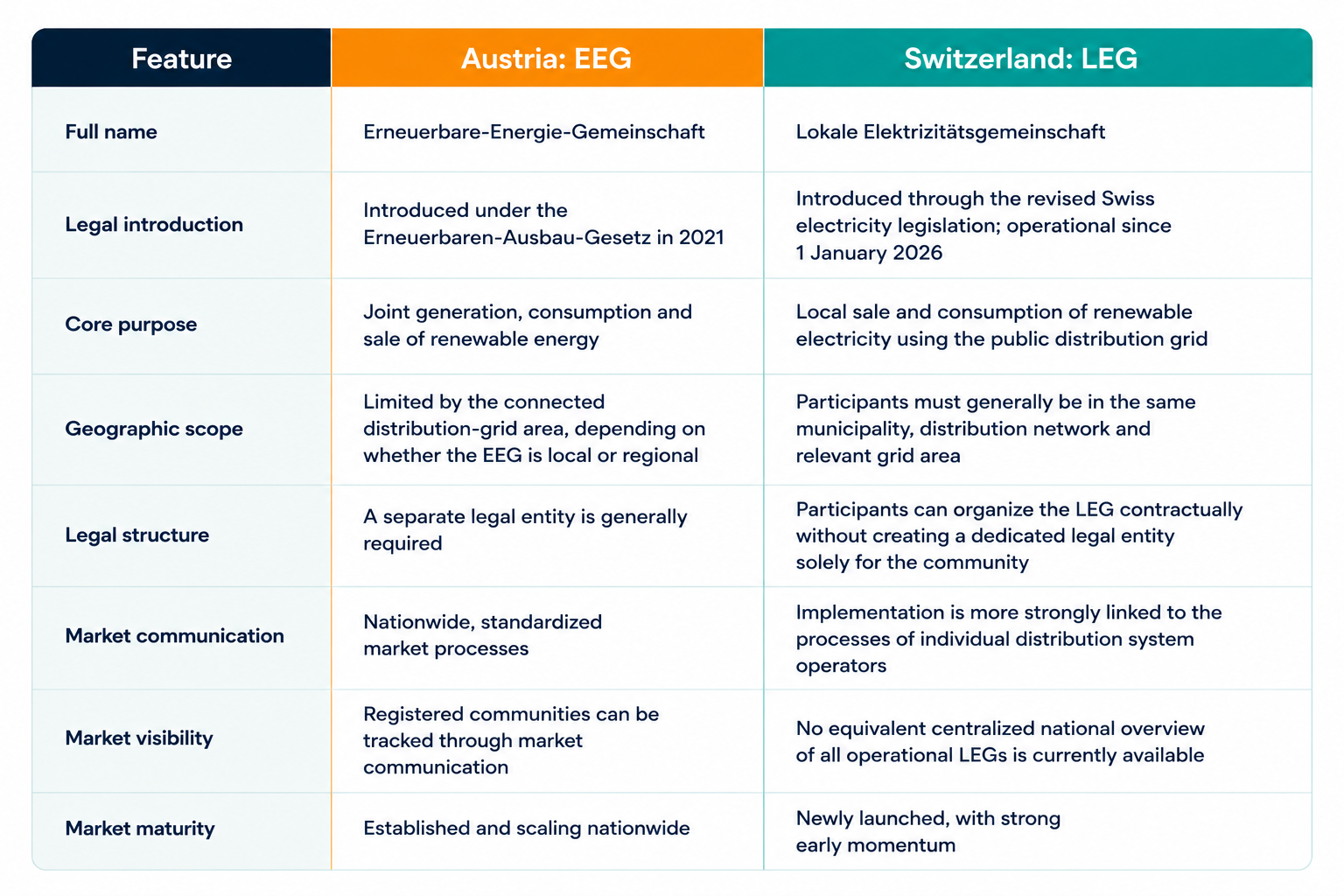
Austria's Erneuerbare-Energie-Gemeinschaften, or EEGs, have been operating since 2021 and have grown into one of Europe's most established energy-community markets. Switzerland's Lokale Elektrizitätsgemeinschaften, or LEGs, became possible at the beginning of 2026 and are already attracting significant interest.
The difference isn't simply that Austria started earlier. The two models differ in how communities are formed, how utilities participate, how electricity data is exchanged, and how customers experience joining a community. Early adoption suggests Switzerland may be able to scale LEGs faster during this first phase of market development – while Austria remains ahead in total market maturity, standardized processes, and nationwide transparency.
Austria built its framework first. The Erneuerbaren-Ausbau-Gesetz (EAG), in force since mid-2021, gave Austrian citizens, municipalities, and businesses the right to form an EEG: a community that jointly generates, shares, and consumes renewable electricity within a defined regional or local area. It was one of the first national implementations of the EU's Renewable Energy Communities concept and made Austria an early European reference point.
Switzerland followed with the revised Stromversorgungsgesetz (StromVG), approved by referendum in June 2024 and rolled out in two steps: virtual self-consumption groups (vZEV) from January 2025, and the LEG itself from January 2026. Unlike the Austrian EEG, where geographic scope is determined by how participants are connected within the electricity grid (the relevant grid level and transformer hierarchy), a Swiss LEG is defined primarily by municipal boundaries: participants can share locally generated renewable electricity anywhere within the same municipality and distribution grid area, regardless of their precise position in the local grid topology. The first LEGs went live in spring 2026.
That five-year head start matters for reading the numbers below. Austria is a mature market; Switzerland is a market in its first months.
Swiss LEGs allow end consumers, renewable generators and storage operators to market locally produced electricity through the public network. Participants must meet geographic and technical conditions, including being connected within the same distribution area and generally within the same municipality.
An Erneuerbare-Energie-Gemeinschaft (EEG) is a renewable energy community in which at least two participants – households, municipalities, small and medium-sized businesses, agricultural businesses, or renewable-energy producers – jointly produce, consume, store, or sell renewable energy. Electricity is the most common use case, though the legal model can also cover renewable heat and gas.
An EEG isn't a conventional electricity supplier. Members keep their normal grid connection and usually retain a supply agreement for whatever electricity the community can't provide; electricity generated within the EEG is measured and allocated among participants according to defined distribution rules.
A Lokale Elektrizitätsgemeinschaft (LEG) allows participants to buy and sell locally generated renewable electricity across the public distribution grid, extending local sharing beyond a single building. Subject to the applicable legal and grid-related requirements, a LEG can connect households, businesses, renewable energy producers (e.g. rooftop PV systems), battery storage systems, electric vehicle charging infrastructure, and public buildings or municipalities – sharing locally generated renewable electricity across a neighbourhood or parts of a municipality using the public distribution grid.
Swiss LEGs became operational on 1 January 2026. To participate, members must generally be connected to the same distribution system operator, be located within the same municipality, use the relevant local grid area, and meet a minimum ratio between generation and consumption capacity – production capacity must amount to at least 5% of the total connection capacity of participating consumers.
Beneath the regulatory differences, EEG and LEG rest on remarkably similar foundations:
Because Austrian distribution grid operators are obliged to report energy-community allocations through a unified market communication standard, the growth of the EEG market is unusually transparent. Smoothing the reported figures into a simplified growth curve:
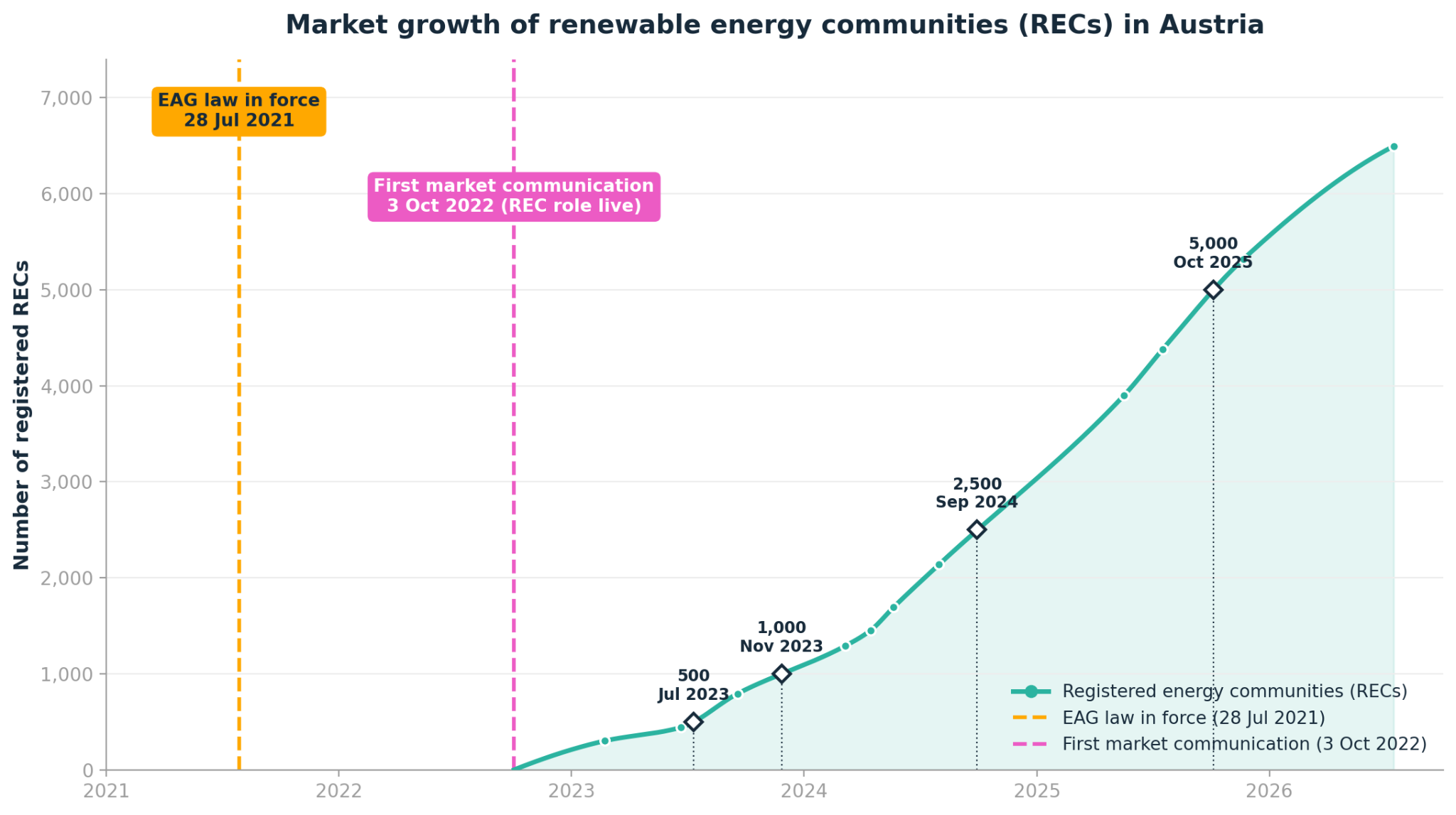
On the consumption side, the Koordinationsstelle Energiegemeinschaften estimated that around 100,000 metering points were already participating in energy communities at the beginning of 2025. Given that the number of registered energy communities has since grown from roughly 4,000 to around 6,500, the total number of participating metering points is likely to be well above 150,000 by mid-2026 – though no official nationwide figure has yet been published for that later date. (source: https://www.awblog.at/klima-energie/Energiegemeinschaften-in-Oesterreich)
In short, Austria moved from several hundred communities to several thousand within roughly three years, on the back of registered national market-communication data. That makes it one of the clearest European examples of energy communities moving beyond individual pilots into a repeatable national market model.
Switzerland doesn't yet have a centralized public register providing a complete, continuously updated LEG count. What's available comes from the platforms actually running communities for utilities – and those figures should be read as market signals, not a national census.
Looking at the utilities running on Exnaton's own platform, more than 150 LEGs were already live by the end of June 2026 – roughly six months after the law took effect – connecting well over 1,000 metering points. Taken together with public statements from other platforms active in the Swiss market, total visible adoption already exceeds 350 live communities and 3,000 connected metering points nationwide – strong early momentum for a framework only six months old.
This is why it would be misleading to compare Austria's ~6,500 registered EEGs directly with the publicly visible Swiss numbers: Austria's registered market communication can count almost every formal community, while Swiss figures are currently fragmented across utilities, technology providers, and individual projects.
Scaling either Swiss figure to a national estimate is where the two markets' structures diverge sharply – and where any estimate needs a health warning. Switzerland has around 650 distribution grid operators, the median one serving under 1,500 end customers; the vast majority are small municipal or cooperative utilities unlikely to have an active LEG product this early. Multiplying observed adoption by the full 650 would badly overstate the market. A more defensible approach applies a much smaller scaling factor – in the order of 10x rather than 200x+ – reflecting that early adoption is concentrated among a limited set of larger, digitally ready utilities. On that basis, a plausible national estimate for mid-2026 sits somewhere in the low thousands of communities, with real uncertainty in both directions until better national reporting exists.
A reasonable conclusion: Austria leads in total adoption and market maturity, while Switzerland appears to be experiencing a faster initial rollout among the utilities already offering LEGs.
It took Austria roughly a year and a half after the EAG entered into force to reach a few hundred communities, in part because market communication standards, billing processes, and grid-operator obligations all had to be built from scratch. Switzerland saw comparable order-of-magnitude adoption within months. Three structural factors help explain this.
Establishing an Austrian EEG typically involves creating or using a legal entity – an association, cooperative, or company – which defines membership, responsibilities, and the distribution of financial benefits, but also introduces real work: choosing an organizational form, drafting statutes and contracts, establishing governance, managing membership, and handling accounting. Many Austrian communities are organized as associations, followed by cooperatives and limited-liability companies; earlier projects often required six to twelve months just to establish.
The Swiss model can rely more heavily on contractual agreements between participants, which can make joining a LEG feel less like founding an organization and more like subscribing to a local electricity product – significantly reducing the psychological and administrative barrier to participation.
Swiss distribution system operators and utilities are central to LEG implementation because they already control or manage customer relationships, grid-topology information, meter data, tariffs, billing processes, and market-facing customer portals. Swiss regulation also gives network operators specific responsibilities, including assessing whether a proposed LEG is technically permissible and providing the information required to determine the relevant grid configuration.
Because the grid operator must be involved in every LEG in any case, the path from the technical grid process to the supplier- and customer-facing side is generally shorter than in Austria. In many Swiss utilities, grid operation, basic supply, and customer service sit within the same organization or closely connected group structures, making it easier to turn the regulatory model into an integrated electricity product covering eligibility checks, metering, allocation, tariffs, billing, and customer communication. In Austria, by contrast, the grid operator, supplier, and energy community operator are often separate parties – so even with standardized market communication, launching and operating an EEG may require more coordination across organizational boundaries.
Once a Swiss utility has established a scalable operational model, it can potentially replicate the service across many customers and communities within its own supply area. This creates a utility-led growth model that differs from Austria's earlier development, which was driven more strongly by municipalities, cooperatives, and individual citizen initiatives.
Switzerland's electricity market is only partially liberalized. All private households, as well as businesses consuming less than 100 MWh per year, are tied to the regulated basic supply of the utility responsible for their local grid area – they cannot freely choose another electricity supplier. Only large consumers above that threshold have access to the competitive electricity market.
A LEG breaks into that monopoly for the first time. It doesn't grant full supplier choice, but it gives households a legal route to source part of their electricity from someone other than the incumbent utility – a local producer down the street, rather than the single entity that otherwise controls their entire supply. In a market where switching supplier simply isn't an option, any mechanism that lets a customer redirect even part of their electricity purchase is the closest thing to competition that currently exists.
A LEG doesn't abolish the utility's statutory supply role, and it doesn't amount to full retail-market liberalization – the local utility still supplies any residual electricity the community can't cover. But it introduces a genuine alternative within an otherwise monopolistic structure: consumers gain real influence over who produces part of their electricity, how that locally generated electricity is priced, and how the value created by renewable generation gets shared. It's a form of partial, local market opening – competition at the level of locally generated electricity, without requiring Switzerland to liberalize the entire household retail market.
That's what gives the Swiss model a value proposition beyond lower network charges or greater self-consumption. LEGs challenge the traditional one-way relationship in which every household must buy all its electricity from the local basic supplier, letting consumers, prosumers, and local businesses participate in a local electricity market while staying connected to the established supply system. It's also one reason Swiss adoption could accelerate quickly: a LEG isn't merely another model for sharing solar electricity – it's the first scalable alternative to the local utility's supply monopoly that Swiss households have ever had. For many customers, that makes it more than a sustainability initiative. It becomes a practical new electricity proposition.
Switzerland may benefit from easier entry, but Austria has built real structural advantages over several years.
Austria's electricity-market communication provides common processes for exchanging participant, meter, and allocation data. Distribution system operators are required to support these processes, and allocated energy values can be exchanged through defined market standards, letting energy communities and their service providers work across different grid territories without designing an entirely new data process for every DSO. For scaling, this is a major advantage: a technology provider can build around one common national process rather than maintaining hundreds of utility-specific workflows.
That same standardization is also why Austria's market is so measurable. Because EEGs are integrated into formal market processes, it's possible to track their development with real accuracy – how many communities exist, where growth is occurring, which processes cause delays, how regulation affects participation, and where infrastructure and education are still required. Switzerland currently lacks a comparable market-wide dataset, which limits its ability to assess adoption and compare implementation performance between utilities.
Austria created the Österreichische Koordinationsstelle für Energiegemeinschaften to support market development. It provides guides for establishing communities, legal and organizational information, contract templates, checklists, educational resources, information on service providers, public example projects, and both virtual and in-person community events – all free of charge and open to anyone. Its online guide takes prospective founders through the required establishment steps.
This national support structure has helped turn a technically complex market model into something municipalities, citizens, and local companies can actually understand and act on.
Austria now has an ecosystem of community operators, legal advisers, energy consultants, software providers, municipalities, cooperatives, installers, and billing and settlement providers. This experience lowers the burden for new communities, because many legal documents, operating models, and technology processes no longer need to be designed from scratch.
The most valuable Austrian lesson is that legislation alone does not create a scalable market. Switzerland would benefit from more standardized data exchange (utilities need common processes for exchanging meter, participant, allocation, and billing data – without national standardization, each LEG implementation may require utility-specific integration work), better nationwide market reporting (a centralized overview of communities, participants, and metering points would make it easier to evaluate adoption and identify bottlenecks), central guidance for customers and municipalities (a dedicated national coordination function could complement existing federal energy programs with more comprehensive templates and process guidance), and more consistent customer journeys (common onboarding and switching standards across utility territories would make LEGs easier to explain and scale).
Austria's next opportunity is reducing the administrative effort involved in founding and operating smaller communities – making contractual models easier to use, simplifying customer participation, enabling more utility-led community products, separating customer onboarding from complex community governance, and automating recurring administrative obligations. Austria's standardized infrastructure is strong, but establishing and managing the legal organization can still discourage customers who simply want to buy or sell local electricity.
The first phase of energy-community development focused on legal enablement. The next phase is operational. As the number of EEGs and LEGs grows, utilities and community operators must manage a genuinely wide operational load: onboarding and offboarding participants, running eligibility and grid-topology checks, processing smart-meter data, allocating energy across members, handling changing member structures, setting community prices, covering residual supply, calculating surplus remuneration, applying network-charge reductions, issuing invoices and credit notes, and keeping customers informed throughout.
Handling these processes manually may work for a pilot with ten households. It does not work for hundreds of communities and thousands of metering points. The decisive question is therefore no longer only whether an energy community can be legally established. It is whether utilities can operate thousands of energy communities accurately, economically, and with a simple customer experience.
Energy communities are becoming a new category of electricity product rather than an isolated regulatory project – a pattern now playing out across markets from Austria and Switzerland to other countries considering similar frameworks.
For utilities, they create opportunities to retain customers through local renewable products, build stronger relationships with prosumers, offer community administration as a service, combine energy sharing with dynamic tariffs and flexibility, create products for municipalities, real estate portfolios and local businesses, and gain experience with more decentralized electricity markets.
They also create operational complexity. Utilities must coordinate regulatory rules, distribution-grid data, time-series allocation, and customer billing without replacing their existing ERP or billing infrastructure. The utilities that solve this operational layer early will be better positioned to scale energy communities beyond pilot projects.
The answer depends on how "ahead" is defined. Austria is ahead in total number of communities, operational experience, standardized market communication, national coordination, market transparency, and availability of established service providers. Switzerland may be ahead in reducing the organizational barrier to entry, positioning communities as utility products, integrating energy sharing into existing customer relationships, generating rapid adoption during the first months of the new framework, and giving households their first legal alternative to a supply monopoly.
It's therefore too early to say Switzerland has overtaken Austria. A more accurate read is that Switzerland may be compressing the early adoption phase that took Austria several years – partly by learning from Austria's market development, and partly by using a less organization-heavy, utility-led model.
Austria has demonstrated that renewable energy communities can develop into a national market. Its standardized communication processes, coordination office, and growing service ecosystem have enabled thousands of EEGs. Switzerland entered later but removed some of the barriers that make communities difficult to establish – LEGs can be organized more like accessible electricity products, with utilities playing a central role in rollout and operation, and with the added pull of being the first real alternative to a household electricity monopoly.
The market data isn't yet directly comparable: Austria has comprehensive registration data, while Swiss figures remain fragmented. Nevertheless, the speed of Switzerland's early rollout suggests LEGs could become a significant part of the country's electricity market.
The most scalable European model may ultimately combine the strongest elements of both countries: Switzerland's simple entry and utility-led customer experience, Austria's standardized market communication and national transparency, automated allocation and billing, and clear incentives for consuming renewable electricity locally.
Energy communities won't scale because of regulation alone. They'll scale when joining one becomes as straightforward for customers – and as operationally manageable for utilities – as launching any other electricity product.
An EEG is a group of at least two participants – households, municipalities, or businesses – who jointly generate, share, and consume renewable electricity within a defined local or regional grid area. It was established by Austria's Erneuerbaren-Ausbau-Gesetz (EAG), in force since 2021, and members save 28–64% on network usage fees depending on the community's geographic scope.
A LEG lets producers and consumers within the same municipality, grid operator area, and grid level trade locally generated solar electricity over the public distribution grid. It was introduced by Switzerland's revised Stromversorgungsgesetz (StromVG) and has been available since January 2026, with a 40% discount on network usage fees (halved if the community spans multiple grid levels).
Independent reporting from the Koordinationsstelle Energiegemeinschaften puts the count at roughly 5,590 EEGs plus about 1,000 Bürgerenergiegemeinschaften by the end of 2025, with the total climbing to an estimated 6,500 EEGs by mid-2026.
There is no unified national count yet, since Switzerland – unlike Austria – has no single market-communication standard for reporting community data. Platform-level data points to triple-digit numbers of live communities within the first six months after launch, with a plausible (but uncertain) national estimate in the low thousands once smaller utilities catch up.
The biggest practical difference is legal setup: an Austrian EEG typically needs a formal legal entity such as an association or cooperative, while a Swiss LEG requires no separate legal entity at all. Austria also has unified national market-communication reporting and a dedicated coordination agency, which Switzerland does not yet have.
No. Unlike an Austrian EEG, a Swiss LEG can be operated without participants first founding an association, cooperative, or other legal entity – participants can be onboarded directly by the grid operator or a service platform.
In Austria, local EEGs save 57% on the network usage fee, while regional EEGs save 28% (grid levels 6–7) or 64% (grid levels 4–5). In Switzerland, LEG participants get a flat 40% discount on network usage fees, halved to 20% if the community spans more than one grid level.