Dynamic tariffs, energy sharing, tenant electricity (Mieterstrom), shared building supply (GGV) and soon MiSpeL: at first glance, these are completely different products with their own regulation, market roles and projects. Look beneath the surface and a different picture emerges. Almost all of them calculate in 15-minute intervals – and almost all of them need the same three building blocks: allocation, aggregation and tariffing, built on a foundation of plausibility-checked time series.
That is exactly the perspective we took in our webinar “Bausteine für neue Energieprodukte: Allokation, Aggregation und Zeitreihen”. Instead of presenting a single use case, we turned the view around: what lies underneath? And why does this layer decide whether a new product stays a pilot or scales?
In this article, we summarise the key takeaways for distribution system operators (DSOs), metering point operators (MPOs) and energy suppliers.
A metering point with a smart meter delivers 96 values per day – 35,040 per year. A dynamic tariff adds the same number of price values. That quickly adds up to more than 70,000 values per customer each year. For standard load profile (SLP) customers, it is still a single meter reading per year. Every ERP can handle interval-metered (RLM) billing for large customers – but not quarter-hours in the mass market.
On top of that, the market and regulation now run on quarter-hours themselves. Since January 2025, every supplier must offer a dynamic tariff (§ 41a of the German Energy Industry Act, EnWG); since April 2025, time-variable grid fees under § 14a Module 3 apply; and since October 2025, the day-ahead market trades in 15-minute products. At the same time, demand for flexible products is growing: around 55% of Germany's gross electricity consumption came from renewables in 2025, 545,000 new electric cars were registered, and millions of prosumers with PV systems, batteries or wallboxes expect tariffs that match their assets. New market entrants are already serving these customers.
Yet when we talk to utilities, we rarely hear about opportunities. We mostly hear about these obstacles:
The motivation differs by market role. The DSO must implement § 14a EnWG and MiSpeL – with as few special processes as possible. The supplier wants to sell new products and retain customers. Both face the same question: can my overloaded IT actually deliver this?
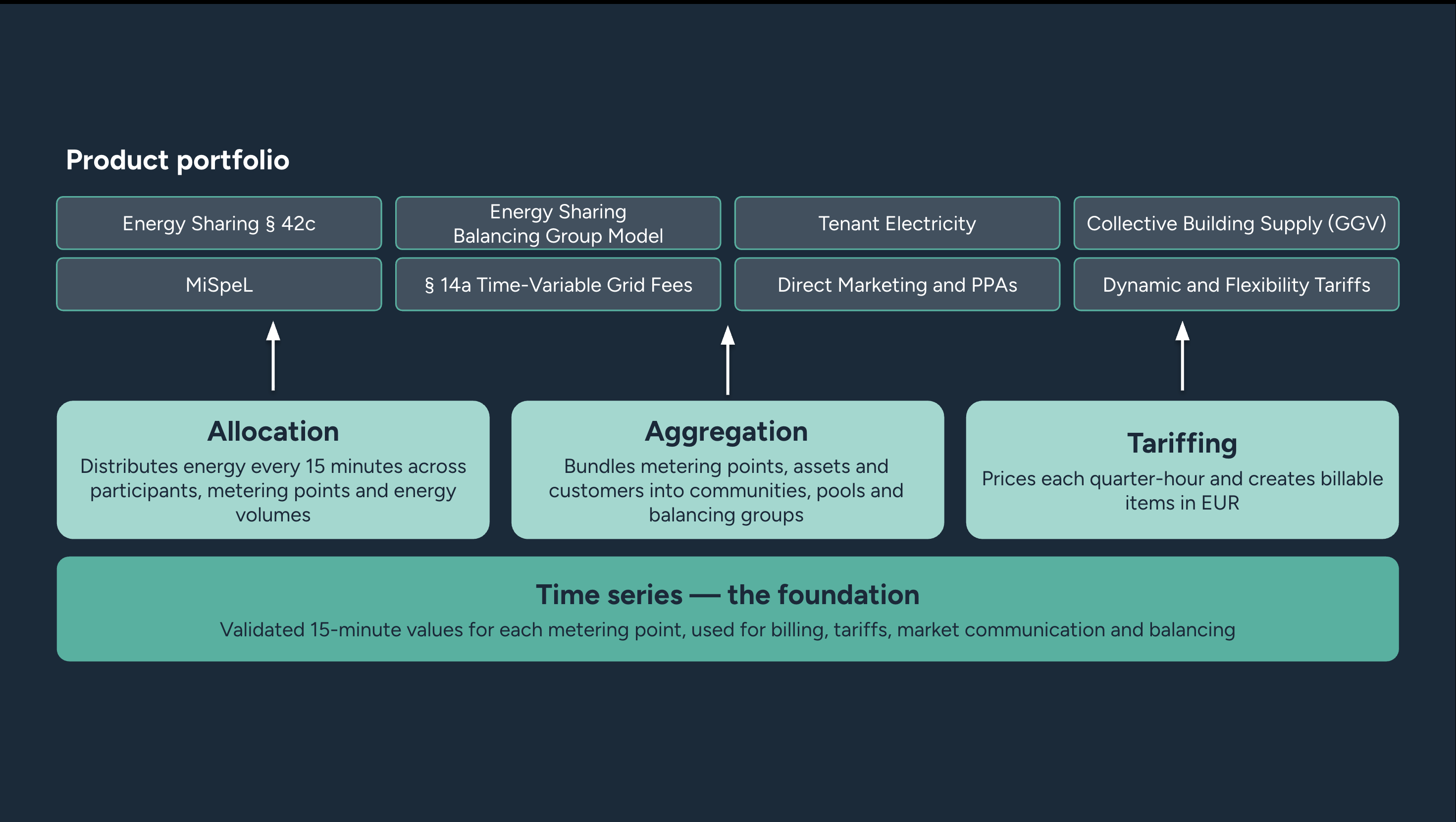
Whether it's energy sharing in the balancing group model, tenant electricity, GGV, § 14a grid fees, complex business customer tariffs with power purchase agreements (PPAs) or dynamic tariffs: the structure is always the same. The details vary by use case and market role; the mechanism stays.
Time series – the foundation. Plausibility-checked 15-minute values per metering point are the basis for billing, tariffs, market communication and balancing. Data quality is part of this: the utility decides whether to bill on measured values or substitute values – and corrects in the following period if needed.
Allocation. How is energy distributed across participants, metering points and volumes in every quarter-hour? This produces values such as community consumption, residual supply and surplus. We use dynamic allocation keys per quarter-hour – in Austrian energy communities, the dynamic key has largely become the standard.
Aggregation. Where the use case requires it, metering points, assets and customers are bundled into communities, pools or balancing groups. These aggregates feed balancing group management, billing and forecasting.
Tariffing. Every quarter-hour is priced: dynamic, time-of-use, fixed, formula-based, with caps and floors, tranches or bonus models. The result is billable items in euros, passed to the ERP in the billing cycle, for example monthly. Invoicing stays where it belongs: in the billing system.
A simplified, fictional example shows how this works in practice. A PV system generates 12 kWh between 12:00 and 12:15. Three participants consume a combined 10 kWh in that quarter-hour. Energy is allocated by consumption, and the remainder goes to the direct marketer as surplus.

RNo residual supply is needed in this quarter-hour. Every market role draws its own values from the same calculation: the supplier bills each participant, the MPO delivers the meter values via market communication, the DSO uses them for grid usage and the market premium, and the direct marketer remunerates the surplus. At the end of the month, all quarter-hours are summed up and passed to the ERP as billable items.
The MPO measures and delivers quarter-hourly values per metering point. The DSO specifies calculation formulas, handles balancing and uses the values for grid usage and the market premium. The supplier assigns local and residual electricity and applies tariffs. The direct marketer bundles surplus and small assets into pools.
The logic is the same; only the goal and its result differ by role.
This leads to the webinar's key message: set up the building blocks properly once, and you can use them across many products and several roles. For municipal utilities that act as DSO, MPO and supplier at the same time, values can be passed directly between separate tenants on request – while maintaining informational unbundling (§ 6a EnWG).
In the webinar, we walked through several use cases. They differ in regulation and data flow, but follow the same logic.
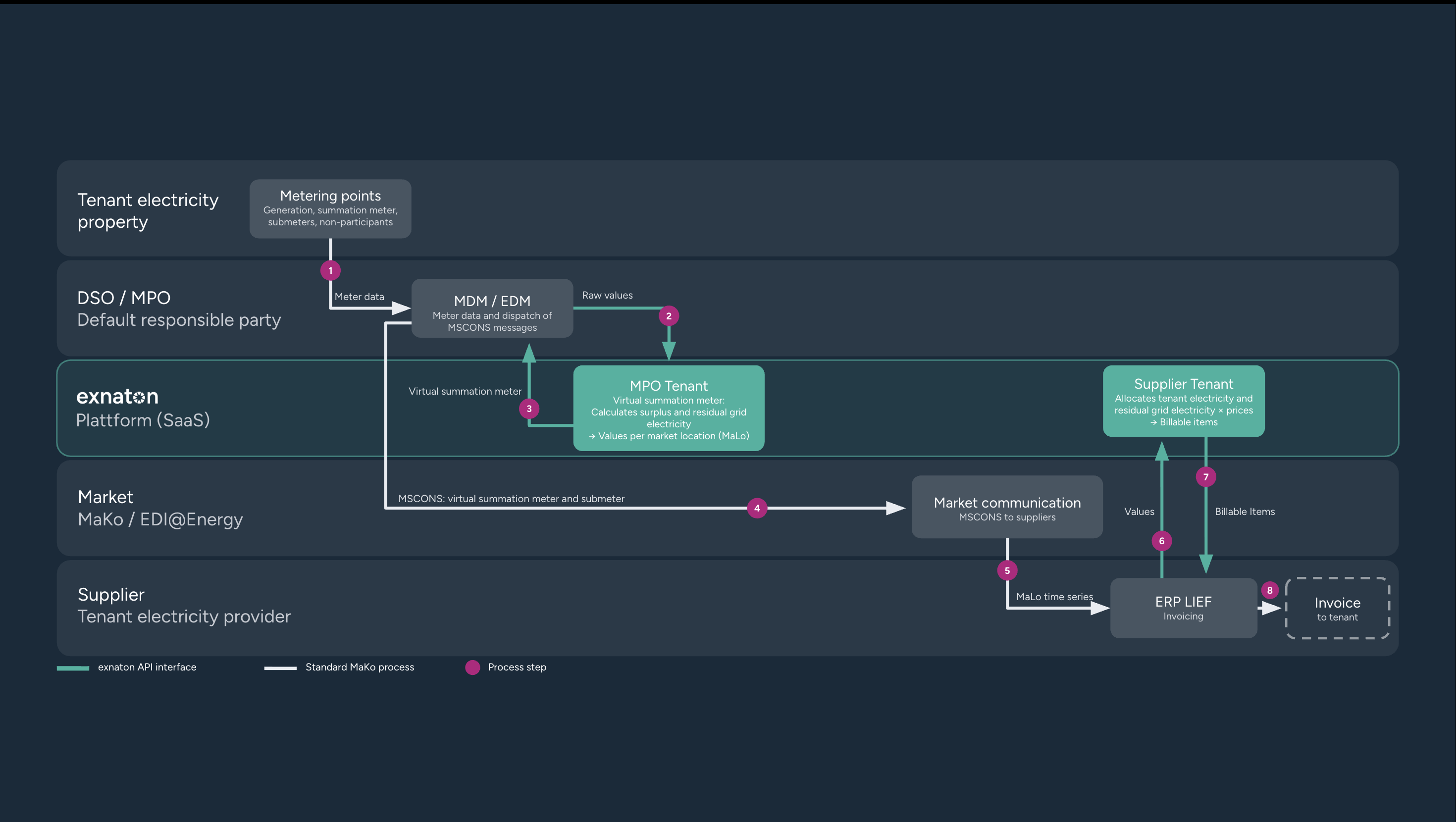
Competitive metering operators often offer virtual summation meter calculations as a service. For the default (grundzuständig) metering operator, the focus is often elsewhere. Here, we pull the meter readings from their meter or energy data management system (MDM/EDM), calculate residual supply, direct consumption and surplus, and return the values to market communication. In the supplier's tenant, volumes are split per apartment and quarter-hour, priced and passed to the ERP as billable items.
MiSpeL, the German regulator's framework for the market integration of storage and charging points, comprises 16 formula sets. Combined with special cases, they add up to around 60 variants. Market communication is expected to be ready only by the end of 2027 – but MiSpeL can already be implemented on a trial basis today. In the DSO's tenant, the values of the grid connection (Z1) and the storage or charging point (Z2) are calculated per quarter-hour and split monthly into volumes that are eligible for subsidies, eligible for netting and subject to levies. This lets the DSO handle grid usage, market premiums and EEG reporting to the transmission system operator. The supplier prices consumption and feed-in. Until the market communication standard is in place, we work with an interim solution via direct interfaces.

For mid-sized and large business customers, electricity products are becoming more individual: multi-site customers combine on-site or off-site PV and wind, tranches and spot volumes. In practice, this usually runs on Excel – time-consuming, error-prone and hard to scale. We map the contractually agreed netting order (for example PV → wind → tranche → spot), split volumes per delivery point and price them. Nothing changes for the DSO or MPO. Suppliers who automate this process ease the load on billing and can turn it into a sales advantage.
Almost every municipal utility has received this request, especially from municipalities: town halls, schools or depots want to use PV surplus at other sites. Because all market locations remain fully in the supplier's balancing group, nothing changes for the already stretched MPO and DSO. Allocation and tariffing happen at the supplier. The model becomes economically attractive mainly with larger generation assets, new or post-subsidy plants, and falling direct marketing costs.
§ 42c EnWG has applied since June 2026. The Bundesnetzagentur, Germany's federal energy regulator, relies on a service model at the supplier rather than allocation by the DSO. A DSO model has therefore been postponed – and for small plants it would rarely pay off economically anyway. EU rules (Art. 15a of the Electricity Market Directive), however, define energy sharing as a partial supply model with a freely chosen residual supplier. If it comes, the DSO would need to calculate community consumption, residual supply and surplus per quarter-hour. The mechanism is the same.
Other applications follow the same pattern, such as § 14a Module 3 for grid usage billing, or prosumer tariffs with dynamic feed-in and dynamic consumption, which we already run in Belgium.
The same mechanism also supports renewable energy communities and citizen energy communities in Austria, as well as local electricity communities (LEG) in Switzerland.
Three or four tenant electricity projects can be handled with Excel or in-house tools. It becomes critical once a product goes broad. One distribution system operator we work with allocates and aggregates 300 energy communities with exnaton:
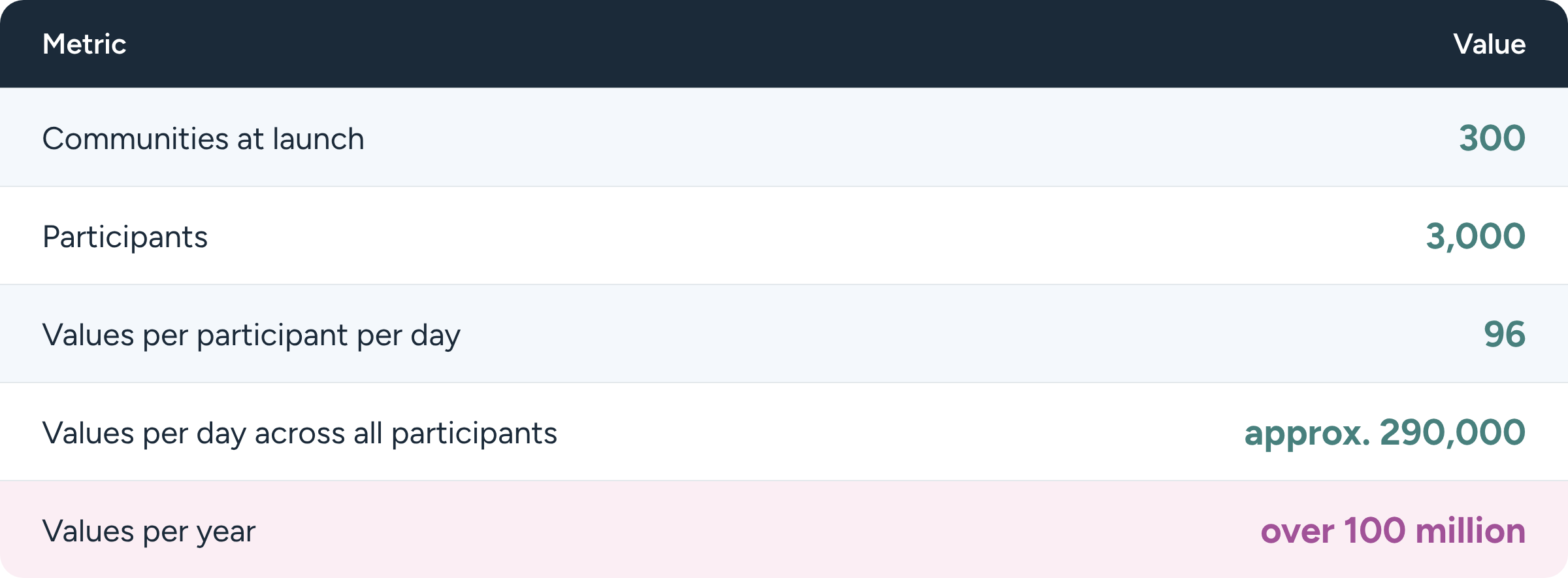
Allocation and aggregation are available at any time for balancing group management, billing and forecasting. For comparison: utilities tell us that billing a single dynamic-tariff customer in their core systems takes several hours per month.
In the end, every utility faces the same question. Build it yourself? A good MVP is feasible – but how many resources will further development take when the balancing group model follows tenant electricity, and prosumer products follow that? Wait for the ERP? Some vendors aim to go in this direction; others prefer to partner with specialists.
We are convinced that modern architectures follow a best-of-breed approach. The ERP remains the leading system for master data and billing. A specialised platform handles time series, allocation, aggregation and tariffing – and takes the load off IT. exnaton is deliberately not an ERP replacement, but an ERP-agnostic add-on and official SAP partner.
Many of these products are still at an early stage: smart meter penetration in Germany is around 6% of all metering locations and just over 26% of mandatory rollout cases (Bundesnetzagentur, June 2026). That's why we support utilities in three phases – with a deliberate decision after each one:
Want to know when a balancing group model, MiSpeL or a PPA product pays off in your supply area? Talk to us – in a potential workshop, we work through your business case and clarify with your IT what integration looks like. Request a workshop.
Missed the webinar? Watch the recording.
Learn how exnaton can help you launch any energy product quickly.
Contact usThies has nearly 20 years of experience in management and product development for smart, data-driven electricity products, including tenant electricity, dynamic tariffs, energy sharing and smart metering.
At exnaton, he leads the sales process and provides energy-sector consulting across Germany, Austria and Switzerland.
See in a demo how exnaton helps you launch new energy products quickly – without a major IT migration.