Energy Sharing in Europe: How Utilities Unlock New Revenue Streams and Customer Value
December 9, 2025
Anastasia Vyshkvarkina
Energy sharing is a rapidly increasing topic of strategic interest in the energy transition. It enables energy suppliers to open new, targeted sales channels for surplus photovoltaic (PV) generation while providing consumers with modern, attractive electricity tariffs.
At the exnaton CONFERENCE 2025, Thies Stillahn, Head of Sales DACH at exnaton, delivered one of the most comprehensive insights yet into the role energy sharing will play in the DACH region. His observations highlight that energy sharing is more than an innovative product concept: it is becoming a foundational element of a resilient, customer-centric energy system.
In this article, we break down the key insights from his presentation — spanning market dynamics, regulatory developments, and concrete implementation models—and outlines what is needed for energy sharing to achieve wide-scale adoption.
Why Energy Sharing Is Becoming Increasingly Important for Energy Suppliers
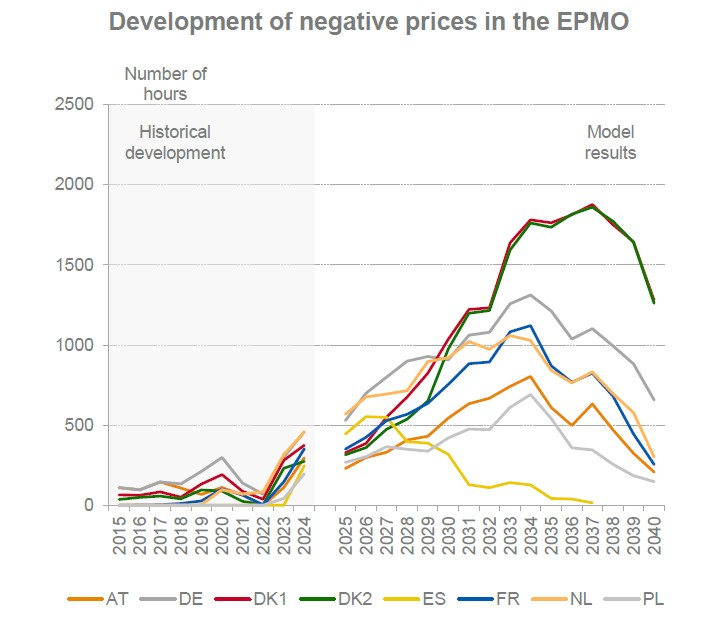
European electricity markets are undergoing profound change. Negative wholesale prices have become markedly more frequent—an unmistakable signal that renewable generation, system flexibility, and market mechanisms are out of alignment and require structural recalibration. In Germany, more than 400 hours of negative prices were recorded by August 2025. Projections foresee as many as 1,300 hours annually by 2032, even assuming substantial storage deployment across Europe.
Figure 1: Renewables Power Market Report 2025 update. Source: enervis.
For operators of renewable assets, particularly PV installations, this trend results in declining or zero remuneration during periods of high generation. In parallel, mechanisms such as the market premium under the EEG framework are being further adjusted and increasingly exposed to market conditions.
This environment creates both pressure and opportunity:
Renewable asset owners need predictable, reliable routes to market beyond the volatility of the wholesale exchange.
Electricity consumers are looking for fair, stable and transparent long-term pricing.
Energy suppliers can expand their product portfolios with innovative offerings that align the interests of generators and consumers within a sustainable ecosystem.
Energy sharing directly addresses these needs. It offers predictable revenues, flexible tariff designs, and can strengthen regional acceptance of renewable projects. Digital transparency—through real-time data and visualisation—enhances trust and creates new opportunities for customer engagement.
Its versatility is particularly compelling: energy sharing can be combined with battery storage, electric mobility, and building-level collective supply models, both locally and across regions.
What Is Energy Sharing? A Simple Definition
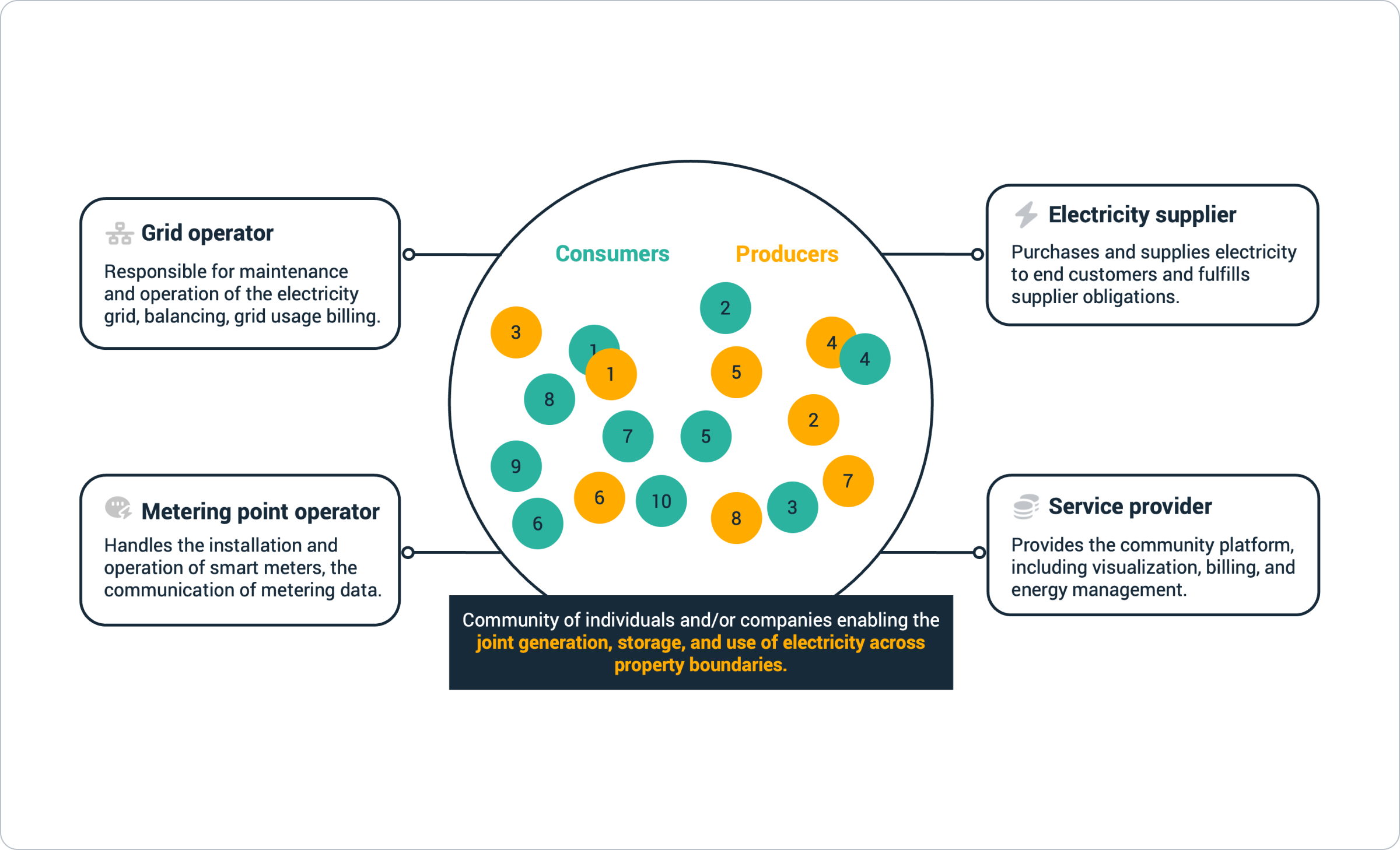
Energy sharing refers to the collective use of renewable electricity generated locally or regionally and distributed via the public grid. It provides a structured mechanism for producers and consumers to participate in a shared model.
Figure 2: How energy sharing works
Core characteristics include:
Implementation as a balancing-group model or partial-supply model, depending on national regulations
Allocation of locally generated electricity within the community, with surplus volumes marketed on the wholesale exchange
Residual supply delivered by the energy-sharing supplier or another retailer Flexible remuneration schemes for injected electricity—fixed, time-variable or dynamic
Corresponding tariff structures for consumption
Accurate quarter-hour allocation using smart-meter data
Potential integration of flexible loads
Energy sharing thus creates a transparent and accountable framework that more closely synchronises renewable generation with consumption.
Where Europe Stands Today: Austria, Switzerland, Germany
Austria — The Most Advanced Energy Sharing Market in Europe
Austria has established itself as a frontrunner in community energy models:
By our estimates, more than 160,000 metering points participate in energy and citizen energy communities
A balanced mix of regional and supra-regional community structures
Smart-meter penetration reaching up to 95%
Network-tariff reductions of up to 57% in local energy communities
Low feed-in tariffs further increase the appeal of sharing
Technical and administrative processes handled via the EDA user portal
Around half of all participants join through utility service providers
Potential expansion into industrial applications and peer-to-peer models
Austria demonstrates how energy sharing can be fully integrated into established market frameworks.
Switzerland — launch on 01.01.2026
With the introduction of Local Electricity Communities (LEGs), Switzerland is implementing a decisive shift:
Legal framework effective from 1 January 2026
Communities organised within municipal or distribution-grid boundaries
Network-tariff reductions of 20–40%
Mandatory smart-meter deployment for participating consumers
Residual supply provided by local suppliers
Switzerland is establishing a future-oriented model that blends regional self-sufficiency with fair competition.
Germany — energy sharing now legally codified, rollout from mid-2026
Germany has taken a significant regulatory step: with the amendment of the Energy Industry Act (EnWG), energy sharing has been legally defined as a partial-supply model under Section 42c EnWG, becoming mandatory for implementation from mid-2026.
Key elements include:
Renewable plant operators may share electricity with end consumers via the public grid
Partial supply complements existing full-supply contracts with the customer’s current supplier
Rollout from 1 June 2026 within a distribution grid; expansion to adjacent grids from 2028
Eligible participants include private individuals, public entities and SMEs
Quarter-hour dynamic allocation keys recommended for assigning generation volumes
Distribution system operators must enable the processes and may delegate tasks to service providers
Plant operators deliver only the shared electricity and are not obligated to provide full supply
Energy Suppliers Can Already Implement Energy Sharing Today via Balancing-Group Models
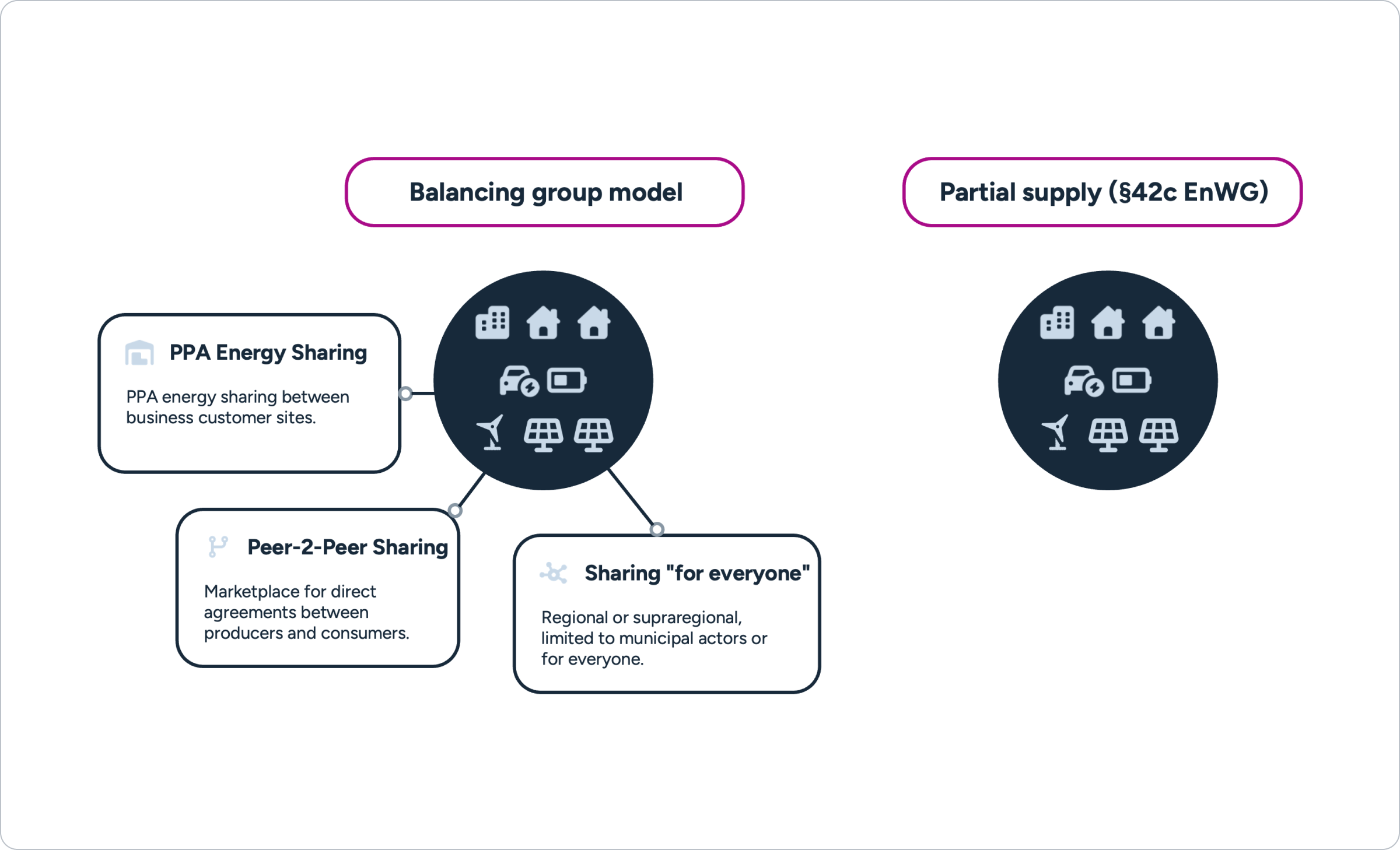
Beyond the statutory framework under Section 42c EnWG, mature balancing-group-based models already allow suppliers to offer energy sharing in a flexible and scalable manner.
Figure 3: A variety of energy-sharing models are possible in Germany.
Energy Sharing with Commercial Customers
For multi-site commercial customers, energy sharing offers substantial advantages. Surplus PV electricity generated at one site can be allocated to another without onsite generation—scalable across the entire corporate portfolio.
Key benefits include:
Increased self-consumption instead of low-value wholesale export
Significant cost-saving potential compared to fixed-price procurement
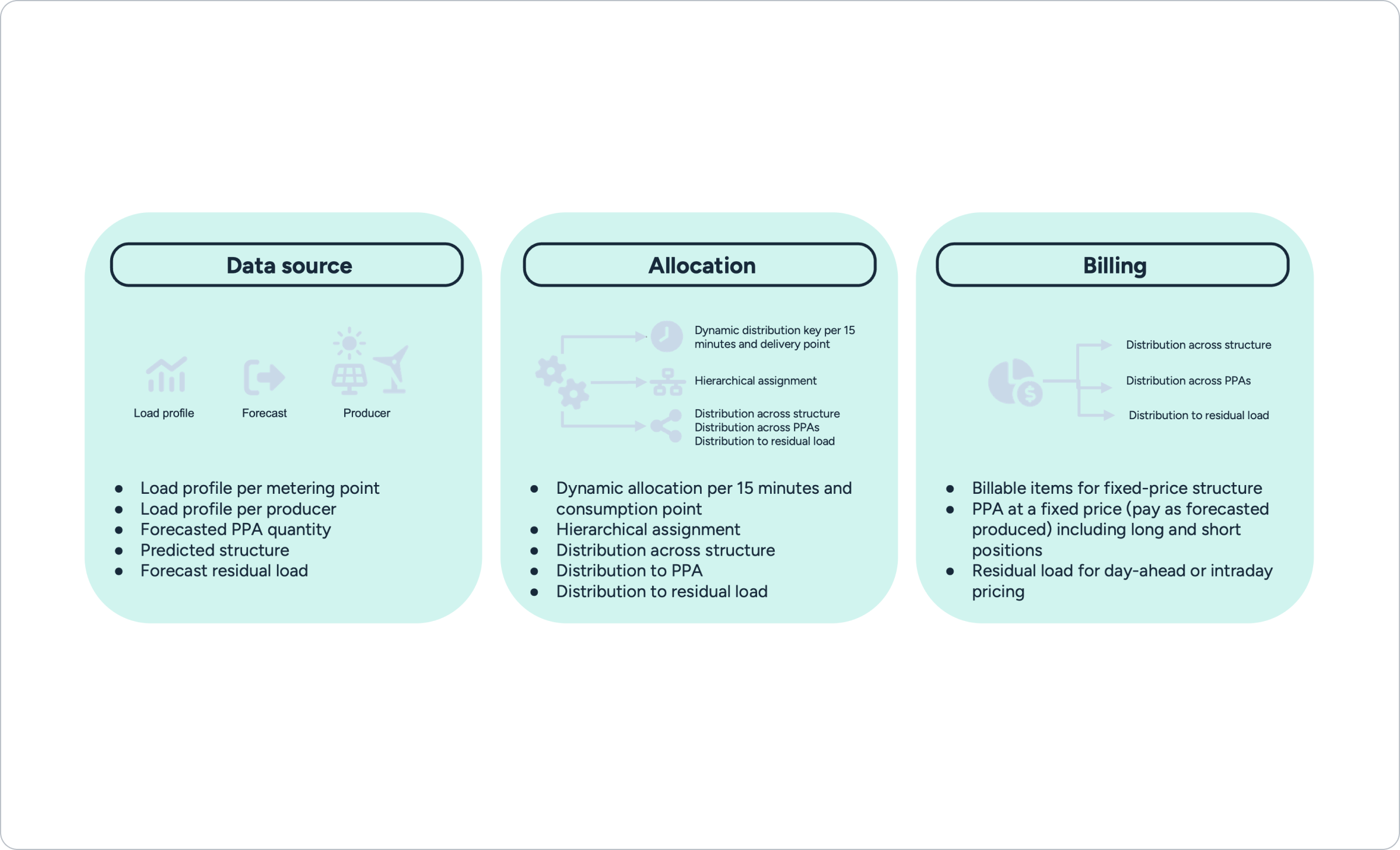
Flexible and sophisticated tariff structures (PPAs, tranches, spot-price components) tailored to corporate consumption profiles
Figure 4: Logics for billing industrial energy contracts with PPA
Cross-company models are also possible, enabling regional economic clusters to pool renewable generation.
Municipality Balancing-Group Model
This model applies the same principles to municipal actors. The aim is to allocate surplus electricity from one municipal entity (e.g. public works) to another without generation (e.g. swimming pool, kindergarten), thereby enhancing local value creation.
Citizen Participation
Citizen participation serves as an extension to all other models. It focuses on financial participation in renewable energy assets, which strengthens identification with local energy systems and enhances societal acceptance of renewable infrastructure.
Peer-to-Peer Sharing
Peer-to-peer sharing enables direct exchange of electricity between generators and consumers through digital marketplaces. The energy supplier acts as an intermediary, managing direct marketing, allocation, balancing and supply.
Benefits include:
High degree of automation
Ability for consumers to switch producers without undergoing a formal supplier switch
Capability to model complex multi-supply relationships
How exnaton Supports Energy Providers: A Full Intelligence Platform for Energy Sharing
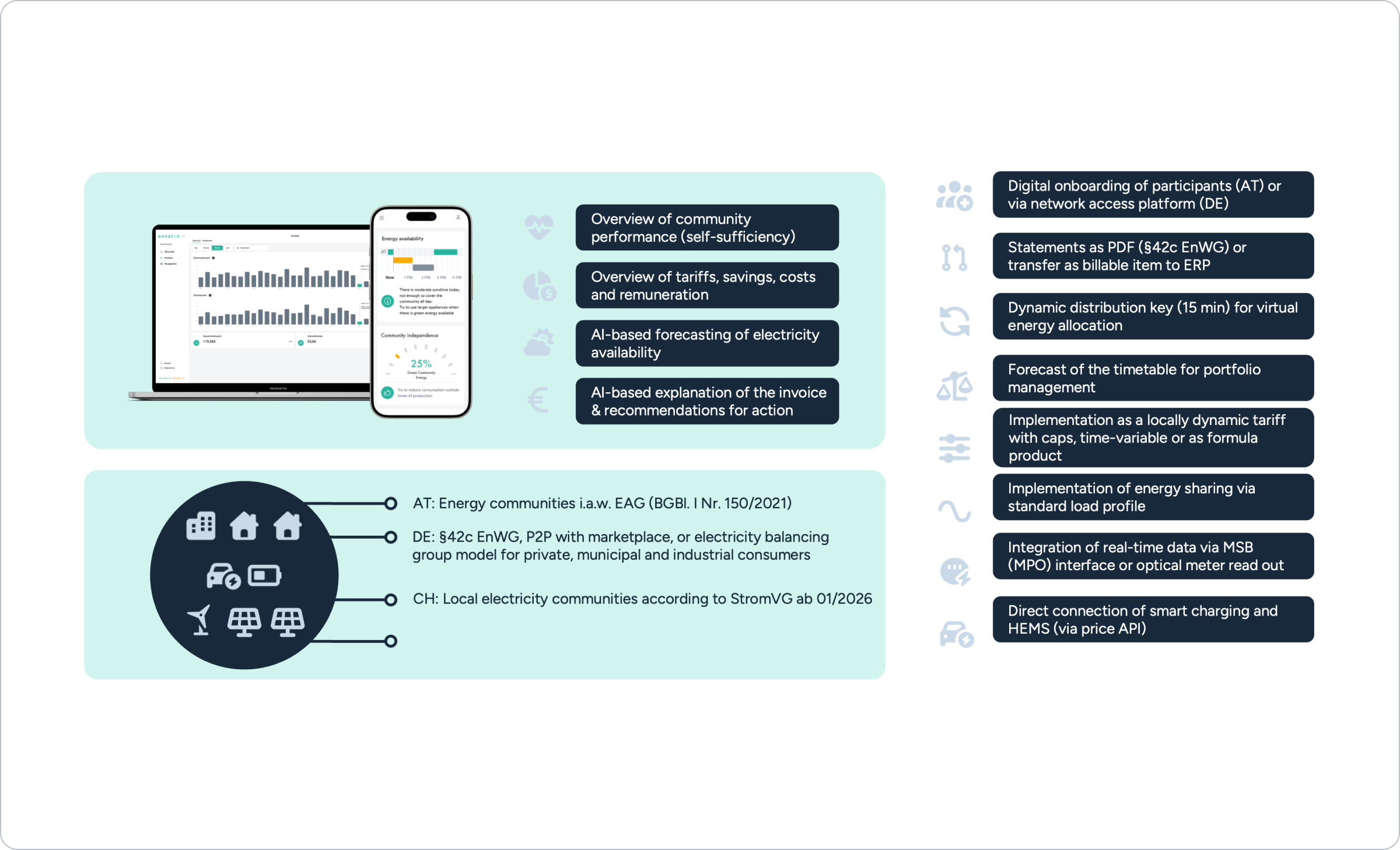
Figure 5: Energy sharing and direct marketing made easy with exnaton
Master Data and Onboarding
Community management handled directly within the exnaton platform rather than in the core billing system
Integration of master data via API or CSV
Participant onboarding workflows depending on regulatory requirements
Energy Allocation
Precise quarter-hour allocation using dynamic distribution keys
Forecasts supporting portfolio and schedule management Full support for all tariff models—fixed, time-variable, dynamic
Optional use of standard load profiles (SLP) or real-time metering data
Billing via Your Core System
Transfer of pre-billing values to ERP systems such as SAP S4HANA (API-based or CSV)
Mapping as billable items within existing processes
Transparency Through End-Customer Visualisation
Clear display of self-supply, community contributions and consumption profiles
Visualisation of remuneration, savings and tariff details
AI-based forecasts of community electricity availability
Explanatory billing notes with personalised recommendations
Integration of Controllable Loads & Real-Time Metering
Processing of real-time data via metering-service interfaces or optical sensors
Integration with smart-charging systems and home energy management systems (HEMS) via price APIs
Regulatory Coverage Across the DACH Region
Austria: Energy communities under the EAG
Germany: Energy sharing under Section 42c EnWG and balancing-group models for private, municipal and industrial customers
Switzerland: Local Electricity Communities under the StromVG from 2026 onward
What Is Needed for Energy Sharing to Truly Scale?
Six factors will be decisive for broad market penetration:
Widespread smart-meter deployment
Onboarding processes as simple as today’s standard electricity tariffs
Low costs for direct marketing
Competitive and attractive pricing models
Transitional models based on standard load profiles
A clear, consistent and easily understandable regulatory framework
Conclusion: Energy Sharing Can Become a Core Pillar of Modern Energy Supply
The rising number of negative wholesale prices makes new marketing pathways indispensable for renewable plant operators. At the same time, dynamic network charges and regional benefits increase the attractiveness of energy sharing for consumers.
Under these conditions, energy sharing is poised to become a standard offering in tomorrow’s energy landscape. It provides:
stable PV revenues
reduced price risk
local value creation
flexibility integration
stronger customer loyalty
diverse tariff models
Energy suppliers that invest now in digital solutions and streamlined processes will shape the energy products of the next decade.
Want to launch Energy Sharing?
exnaton helps utilities implement energy communities, peer-to-peer models, dynamic tariffs, and flexibility products — fast, compliant, and customer-friendly. Get in touch with our team.