
exnaton is a climate tech company empowering utilities to launch smart, data-driven energy products – fast and future-ready.
Trusted by 50+ utilities across five countries, exnaton provides a modular, AI-powered SaaS add-on that integrates seamlessly with existing utility core systems like CRM, ERP and billing systems via APIs. By enhancing legacy infrastructure and customer experience platforms, utilities can launch modern, customer-centric offerings – such as P2P energy sharing, PPAs, dynamic tariffs, and intelligent EV charging – in weeks rather than months, without replacing core systems or investing in costly hardware.
The name exnaton reflects both our origins and our vision for the future of energy.
At its core, exnaton combines the ideas of energy and exchange. From the very beginning, we believed that the future energy system would not be based on one-way consumption, but on active participation: people producing, sharing, storing, and intelligently using energy together.
The name also draws inspiration from the Egyptian pharaoh Akhenaten, who elevated the sun to a central role in society – a symbolism that resonated with the rise of solar power and the shift toward decentralized, participatory, and community-driven energy systems.
This vision didn't emerge in theory – it came directly from our founders' real-world experience. During their PhD research at ETH Zurich and the University of St. Gallen, Liliane Ableitner, Anselma Wörner, and Arne Meeuw worked on the "Quartierstrom“ research project in the Swiss town of Walenstadt, helping build Switzerland's first local energy community. Around 40 households generated solar power and traded electricity directly with one another.

The experience revealed something much bigger than a technical experiment. People were no longer passive electricity consumers – they were becoming active participants in shaping their own energy future. It became clear that the energy transition would require entirely new digital infrastructure capable of supporting local energy sharing, dynamic pricing, prosumer models, and empowering truly flexible energy consumption.
But those tools did not exist. So we built exnaton.
exnaton is built for organizations that need to turn complex energy data, regulation, and infrastructure into scalable, customer-facing products - fast.
Our core customers are utilities and energy suppliers launching modern energy products like dynamic tariffs, P2P, energy sharing, and prosumer models on top of existing ERP systems.
We also serve:
The energy sector is undergoing a structural transformation driven by decentralization, electrification, and regulation. More households are installing solar panels, adopting electric vehicles, and using heat pumps. Energy is no longer flowing in one direction – from utility to consumer – but has become bidirectional, dynamic, and increasingly complex.
Utilities are expected to offer innovative products such as dynamic tariffs, energy sharing models, and prosumer offerings. At the same time, regulatory frameworks across Europe are pushing for exactly these kinds of solutions. Meanwhile, agile new entrants – from digitally native energy retailers like Tibber and 1KOMMA5° to tech-enabled players like Octopus offering integrated services and customer-specific tariffs – are capturing market share by delivering exactly what traditional utilities struggle to provide: bundled solutions, seamless customer experiences, and flexibility services.However, most utilities are still operating on legacy IT systems designed for a completely different era – one defined by fixed pricing, low data volumes, and simple billing logic. As a result, complex energy products are often managed through Excel-based solutions in a shadow IT manner, creating operational risks, scalability issues, and compliance gaps.
This creates a fundamental bottleneck. Innovation is required urgently, but existing systems make it slow, expensive, and risky to deliver. Many utilities struggle with long development cycles, limited IT resources, and the inability to process high-frequency data or complex tariff structures.
A real example illustrates this challenge well: a mid-sized Austrian utility wanted to launch an energy community product to retain customers with solar installations. While the business case was clear, they faced significant hurdles in regulatory compliance, data processing, and billing complexity. With exnaton, they were able to launch a fully compliant product in just a few weeks – integrated into their existing systems and ready for market.
exnaton solves this problem by acting as a flexible SaaS layer that manages the complexity of modern energy products outside of core systems. Instead of forcing utilities to rebuild their infrastructure, it integrates seamlessly via APIs and enables them to innovate on top of what they already have.
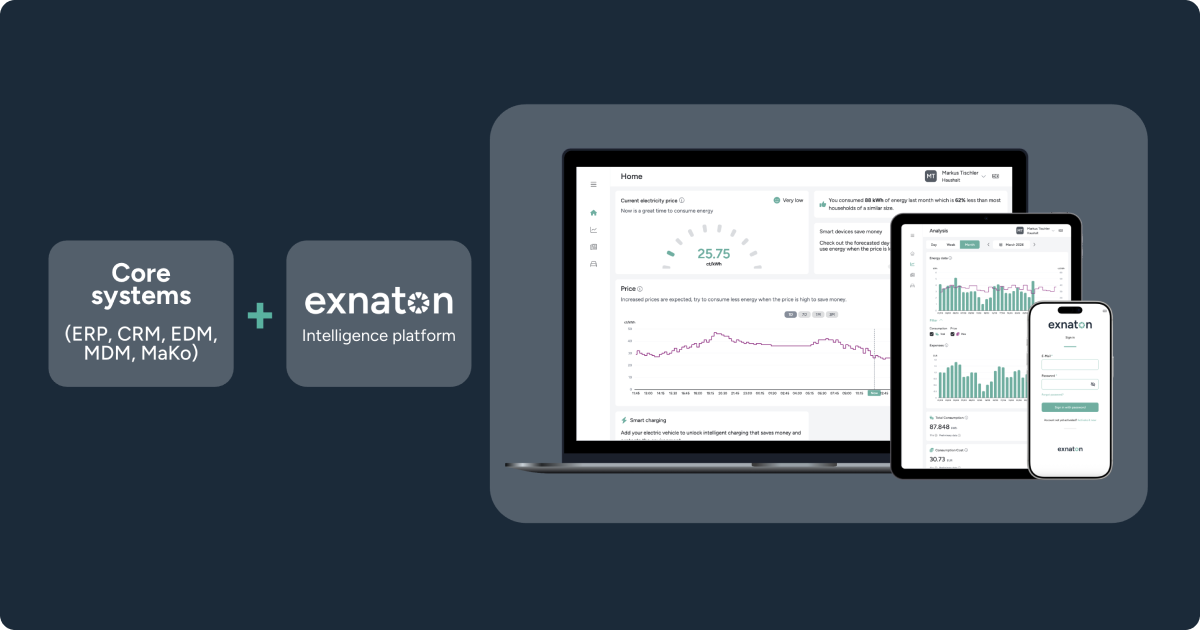
The platform processes high-frequency time-series data – including consumption, production, pricing, and forecasts – and translates it into structured tariff logic and billing-ready outputs. This includes handling dynamic exchange-based tariffs, time-of-use pricing, local pricing signals, and even complex models with multipliers, offsets, and regulatory components.
What makes this particularly powerful is that exnaton doesn’t just calculate prices – it operationalizes them. Utilities can design, test, and launch entirely new products, from dynamic tariffs to energy sharing models, and bring them to market in weeks instead of years.
At the same time, exnaton connects the backend with the customer experience. Through white-label portals and integrations, end users can understand their consumption, respond to price signals, and actively participate in the energy system.
exnaton enables utilities to quickly launch time series-based smart energy products with a tailored customer experience:
The shift toward renewable energy has made electricity inherently variable. Prices fluctuate based on supply and demand, and local grid conditions increasingly matter. exnaton enables utilities to translate this complexity into structured, customer-facing products.
Dynamic tariffs, for example, allow utilities to pass wholesale market prices directly to consumers, incentivizing them to shift consumption to cheaper and greener hours. Time-of-use tariffs introduce structured pricing periods, while more advanced models incorporate local grid signals or flexibility incentives.
Energy sharing takes this a step further by enabling multiple participants – such as households in a neighborhood or tenants in a building – to share locally generated renewable energy. exnaton handles the allocation, billing, and visualization of these models, making them scalable and operational.
The platform also supports prosumer tariffs, where customers both consume and produce energy, as well as smart EV charging use cases. By sending price signals directly to Home Energy Management Systems (HEMS) or connected devices, exnaton enables real-time optimization of energy consumption.
Technically, exnaton is built as a modular, cloud-based SaaS platform with an API-first architecture. It integrates into existing ERP systems such as SAP without requiring modifications, which significantly reduces implementation time and risk.
The system processes more than 70,000 data points per customer per year, combining market prices (such as day-ahead and intraday data), grid fees, taxes, and consumption data into a unified billing logic. This allows utilities to generate accurate, transparent bills even for highly complex tariff structures.
Beyond billing, exnaton also enables forecasting and automation. Its AI-driven models generate price signals and consumption incentives, helping utilities manage volatility and optimize energy usage across customer portfolios. These signals can be delivered directly to devices like EV chargers, batteries, or heat pumps, unlocking flexibility at scale.
Unlike traditional billing systems or platforms that require full ERP replacement, exnaton is designed as a no rip & replace add-on that integrates seamlessly into existing IT landscapes. This approach allows utilities to innovate quickly without large transformation projects.
Many competing solutions focus on individual use cases – such as energy communities or device optimization – but lack the ability to handle billing complexity at scale. Others, like ERP replacement platforms, require multi-year implementations and significant investment.
exnaton takes a different approach. It combines tariff logic, time-series processing, billing, and customer experience into one modular platform, enabling multiple business models within a single system. This makes it possible for utilities to move from static pricing to fully dynamic, data-driven offerings.
The energy transition is not just about generating renewable energy – it’s about using it intelligently. The future of energy is dynamic.
The real question for utilities is no longer whether to innovate but how to do it quickly, efficiently, and at scale.
exnaton provides that answer.